
 FEATURED
Campus free speech group says it’s still keeping an eye on the situation
A lecturer at Indiana University’s School of Social Work returned to the classroom this winter following her temporary removal over an “intellectual diversity” complaint about linking the “Make America Great Again” slogan to “white supremacy.”
However, lecturer Jessica Adams said she remains under administrative monitoring — which has prompted free speech concerns from a campus legal group.
“Monitoring a faculty member’s teaching to ensure that nothing offensive or upsetting is taught could be a violation of that faculty member’s pedagogical autonomy if the faculty is unable to teach their class material freely,” Graham Piro with the Foundation for Individual Rights and Expression told The College Fix recently.
Adams initially had been removed from her “Diversity, Human Rights, and Social Justice” class in the fall after a student reported her for how she discussed the topic of “white supremacy” in the classroom, The Indiana Daily Student reported.
The complaint mentioned a graphic Adams used called “The Pyramid of White Supremacy.” It included examples such as “Make America Great Again” and “Columbus Day,” according to the report.
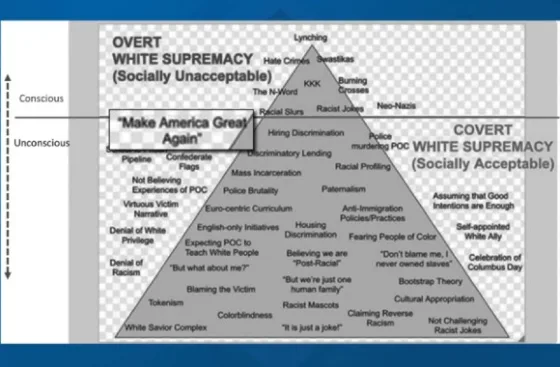
As a result of the complaint, Adams was investigated and found guilty of violating a 2024 state law that aims to expand diversity of thought and civil discourse in higher education, according to the student newspaper.
The law, among other things, requires public colleges and universities to promote “cultural and intellectual diversity.” It also allows students to submit a formal complaint against faculty if they do not follow the law regarding free inquiry, free expression, and intellectual diversity in the classroom.
During a protest on Dec. 5, Adams told a crowd that she had returned to class, but all her classes were being monitored by the School of Social Work’s director, the student newspaper reported. Adams said her academic freedoms are being infringed upon, and she plans to appeal the university’s findings.
Adams did not respond to two emails from The College Fix over the past month, asking what conduct IU determined violated state law and what sanctions were imposed on her as a result of the ruling.
The Indiana University Bloomington Association of University Professors released a statement last month condemning Adams’ removal from the classroom and linking it to other alleged failures by university leaders to uphold “principles of free speech and institutional neutrality.”
It cited the removal of “Adams from teaching a class on diversity and social justice because she attempted to teach about white supremacy” as evidence of their failures to live up to the Chicago Principles that the university administrators claim to endorse.
The union called on the chancellor and president to follow through on their commitment. The Chicago Principles state, in part, “Because the University is committed to free and open inquiry in all matters, it guarantees all members of the University community the broadest possible latitude to speak, write, listen, challenge, and learn….”
Indiana University’s media relations office and the AAUP did not respond to The Fix’s requests for comment about Adams’ situation.
But Piro, faculty legal defense fund fellow at FIRE, expressed concerns about the university’s actions in a recent email to The Fix.
“Indiana has long been a bad actor on First Amendment issues, whether it was the cancellation of Palestinian artist Samia Halaby’s art exhibit or its censorship of a student newspaper,” Piro said.
He said academic freedom “protects the right of faculty to determine how best to approach difficult or potentially upsetting material in their classrooms,” as long as that material is relevant to the instruction.
He said this level of monitoring in Indiana “could chill absolutely a faculty member’s ability to teach,” and he “cautions any public university that the First Amendment provides significant protections for faculty members in the classroom.”
Piro told The Fix that FIRE will continue to monitor the situation to “ensure that IU does not continue to violate the First Amendment.”
Indiana University has dealt with similar instances in the past, including when Germanic studies Professor Benjamin Robinson was reported in 2024 through a “Bias Incident Report.”
According to Indiana Public Media, Robinson received a reprimand for violating the same state law as Adams. The complaint alleged he “used class time to criticize the university’s free speech policies and Israel.” According to the report, he previously had been “warned for discussing Israel and the war in Gaza,” and for “describing his personal experiences and criticizing the university.”
MORE: Transparency or threat? UNC policy to make syllabi public draws mixed reactions

