BUZZ
BUZZ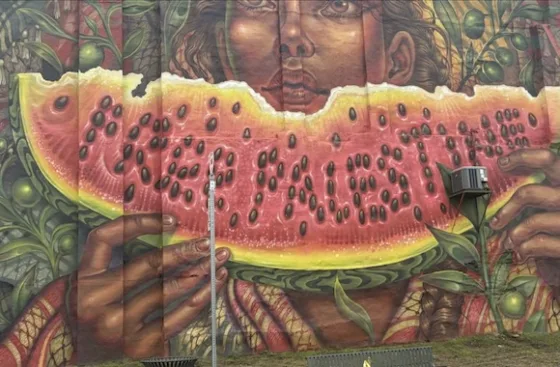
Mural creator: ‘Any similarities to harmful imagery are completely unintentional […] From the rind to the seed, Palestine will be free.‘
An intersectional conundrum, for lack of a better term, has reared its head in Richmond, Virginia, where a pro-Palestinian mural featuring a watermelon has irked some in the black community.
The Northside neighborhood mural “depicts a darker-skinned” woman with seeds spelling out “Free Palestine” across the watermelon, WWBT 12 On Your Side reports.
The watermelon as a Palestinian symbol comes from the 1967 Six-Day War when Israel defeated the armies of Egypt, Syria, and Jordan … and then “occupied” the West Bank and Gaza Strip, according to Virginia Commonwealth University Professor Faedah Totah.
Totah, who teaches in the School of World Studies, said because Israel “banned the Palestinian flag,” Palestinians “became creative in finding different ways to express their national identity.” The colors of the Palestinian flag are that of a watermelon — red, white, black, and green.

Totah said each color symbolizes an aspect of Palestinian existence: green for grassy fields, red for blood “spilled in the name of liberation and independence,” black for “rage,” and white “probably” indicates “righteousness” (she couldn’t quite remember).
Besides the watermelon, Totah said other Palestinian symbols of “national belonging” include the olive tree, the Dome of the Rock, and the cartoon character Handala.
Nevertheless, former president of the Richmond Crusade for Voters Jonathan Davis said he was “taken aback” by the painting.
“[T]o me, understanding the history of our people and what happened during the Jim Crow era and how those images were used to demean us and make fun of us and ridicule us and run us out of the business, it really bothered me,” Davis said.
Southern Christian Leadership Conference Richmond Chapter President William McGee noted the watermelon actually had been a “positive” symbol in the black community, “but it was used to denigrate other people.” He said the mural could be “modified [to] help the cause for both African-American freedom and justice and for the Palestinian cause.”
Civil rights activist Gary Flowers said there’s been a “60-year alliance” between the U.S. black liberation movement and the free Palestine movement in the Middle East. He suggested the mural be replaced with one featuring both the black liberation flag and the traditional Palestinian flag to “symbolize th[e] unity of aspirational liberation.”
Mural creator Lauren S. said the woman on the mural “is meant to be Palestinian” and “any similarities to harmful imagery are completely unintentional.”
Part of Lauren’s official statement read “From the rind to the seed, Palestine will be free. I paint this as a message of hope to the Palestinian people- as symbolized by the enduring spirit of plant life despite cruel conditions.”
MORE: School district apologizes for offering chicken and waffles, watermelon for Black History Month