
 FEATURED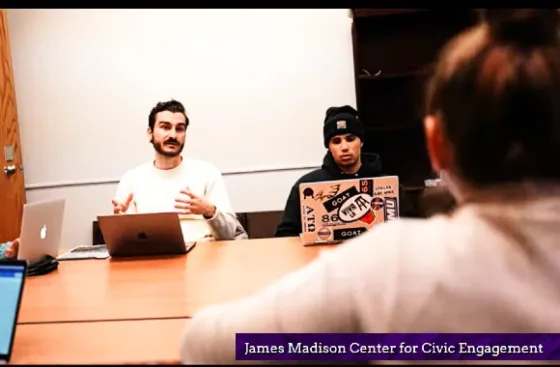
University is recipient of civics education grant from Trump administration
James Madison University is expanding its civic education efforts through a recent $2.72 million federal grant — part of a larger effort by the Trump administration to support American history and civil discourse.
A historian who spoke with The College Fix praised the effort to expand civics education but wondered how much “left-wing” ideology that dominates academia will affect these projects.
The public university in Virginia is one of 16 higher education institutions that received the civil discourse grant from the Department of Education in January, it announced in a recent news release.
“This nearly $5 million investment affirms JMU’s position as the national leader in civic education and deliberative discourse,” Kara Dillard, the program’s director and executive director of the center, stated in the news release. The university also received a $2.1 million federal grant in September to fund civic education.
“James Madison himself championed deliberation as the cornerstone of democratic self-governance – the belief that through reasoned debate and careful consideration of diverse perspectives, citizens can reach sound decisions for the common good,” Dillard stated.
The university media relations office referred The College Fix to the news release when contacted for further comment on its civics initiatives and the grant.
Both grants support the work of the James Madison Center for Civic Engagement. The newest one specifically will be directed toward expanding its Better Conversations Together Program.
The program focuses on helping students have respectful in-person conversations about difficult and divisive topics, according to its website.
“As people reason together in deliberation, they listen to each other, explore facts, test ideas, weigh options and balance tradeoffs to find where their various interests overlap—where purposes can be joined towards a shared future,” the website states.
With the new grant money, the university plans to expand the program to “40 campus anchor universities (at least one per state) and about 40 faculty fellows and 30,000 students, including students of two- and four-year colleges,” according to the news release.
More specific plans include developing a “national faculty fellows program for researching and implementing deliberative pedagogy” and hosting “writing and deliberative pedagogy seminars and workshops.”
The grant also will be used to “[e]stablish a rigorous evaluation process of civil discourse understanding and skills spanning K-16,” with the goal being to improve students’ deliberation and civil discourse skills “across political differences,” the news release states.
When asked about the Trump administration’s grants and James Madison’s program, historian Mary Grabar said she could not comment on the specifics without knowing more about the plans and the scholars in charge.
“I am in favor of civics education and old-fashioned scholarly debate,” she told The College Fix in an email last week. Grabar is a historian, author and the founder of the Dissident Prof Education Project. She is known for her books “Debunking Howard Zinn” and “Debunking the 1619 Project.” Grabar has taught at a number of colleges and universities in Georgia.
However, she expressed concerns about “left-wing ideologues” in higher education using the federal grants to further their own agenda.
“Unfortunately, left-wing ideologues often market their programs as advancing the purpose of the grants,” Grabar said. “But I’ve seen too many civics discussions and debates on campuses that were between a leftist and a squishy conservative or moderate who did not defend the conservative position. The moderators were always left-wing ideologues.”
“Civics education programs are good only if the participants are honest scholars engaged in good faith debate, regardless of their personal political views,” Grabar said.
Research supports that college faculty tend to lean left politically. For example, a recent Yale Daily News investigation found that 98 percent of political donations from Yale University professors went to Democrats, The Fix reported in January.
Fostering civic dialogue and “patriotic education” is an educational priority of the Trump administration.
James Madison University’s grant is a part of a larger $169 million package announced in January by the Fund for the Improvement of Postsecondary Education, which the Department of Education oversees.
One of the goals is to help “grantees foster diverse viewpoints on campus,” Assistant Secretary for Postsecondary Education David Barker stated in a department news release.
In recent months, a number of universities followed the administration’s lead, increasing investments in civic preparedness from the previous year, according to an Institute for Citizens and Scholars report in December.
The trend of increasing investment in civic dialogue comes as concerns over the state of public discourse on college campuses rise. This year, the Foundation for Individual Rights and Expression gave America’s college campuses an “F” rating for poor free speech climate.
Research also suggests the United States is lacking in civic literacy. A 2024 study conducted by the U.S. Chamber of Commerce Foundation found that over 70 percent of Americans failed a basic civic literacy test.
MORE: UCLA staff ‘talk to’ lonely Native American museum pieces at tribe’s request

