FEATURED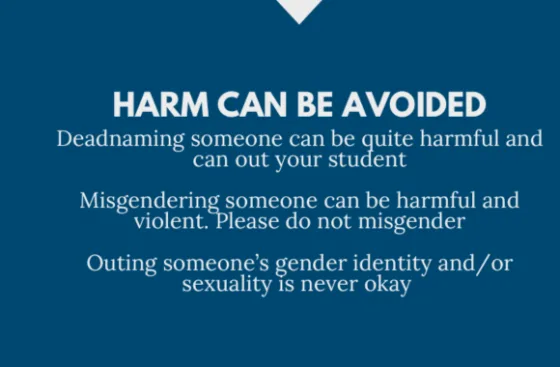
Free speech groups say recent court cases affirm right to not use someone’s made-up identity
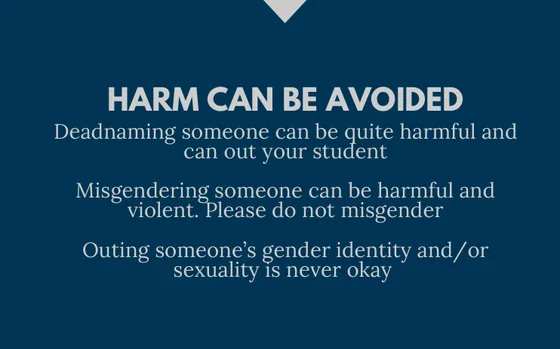
It is “harmful” and “violent” to refer to someone by their true sex, according to a guidance sheet from West Chester University’s “Center for Trans and Queer Advocacy.”
“Misgendering” refers to not using someone’s declared gender, as in the case of a man who claims to be a woman or vice versa. Using the biologically accurate language “can be harmful and violent,” the faculty resource guide states.
Likewise, “deadnaming,” or referring to someone by their real name, “can be quite harmful.”
The guidance sheet, called “Faculty Guide to Supporting Trans & Queer Students,” explains how staff should handle trans and queer students. In the document, it goes over many methods and requests faculty members to become advocates by asking “In what ways have you shown up as an advocate? Inside and out of the classroom?”
Professors are also encouraged to share their pronouns to “normalize” the practice.
“Consider putting pronouns on business cards and/or on your Zoom name. We have a demo for that!” the document states. The center separately offers other resources, including “Trans Joy” coloring books and guidance on name changes.
The public relations team for the university did not respond to an email sent in the past week. The College Fix reached the transgender center by phone on Aug. 26, but it told this reporter it would need a week to look into him.
The center has not followed up from that phone call or an email sent Aug. 20, asking how misgendering is violence, if professors should be punished for using the wrong gender (as perceived by the student), and how to balance free speech with gender concerns.
However, several free speech experts said the university is making mistakes by instructing faculty about the harms of not using someone’s declared gender.
The faculty guide could be seen as a suggestion for behavior but “a policy compelling the use of preferred pronouns and names intrudes on the right to private conscience and, in the case of a public university, violates the First Amendment,” Laura Beltz told The College Fix via email.
Beltz, with the Foundation for Individual Rights and Expression, said a university could step in if there is a “persistent and targeted use of a student’s non-preferred pronouns or name” if it “amounts to harassment.”
“But absent more, a faculty member’s mere refusal to use a person’s preferred pronouns or name is protected speech,” Beltz said.
She cited the example of Professor Nicholas Meriwether at Shawnee State University. Meriwether “alleged his rights were violated when administrators insisted he refer to a student using particular pronouns.”
As the free speech expert noted, “the U.S. Court of Appeals for the Sixth Circuit held that he had a strong First Amendment interest in refusing to use a student’s stated pronouns, because they carried an ideological message with which the professor disagreed.”
Shawnee State, in Ohio, paid out $400,000 to end the legal battle, as The Fix previously reported.
The Independence Law Center described the guide as “Orwellian.”
Chief Counsel Randall Wenger said if “a public university tells faculty that certain words can constitute violence, censorship and punishment can be recast as protection.”
“It should concern every American when a government institution entrusted with higher education uses its institutional authority to pressure students and faculty toward ideological conformity rather than the pursuit of truth,” Wenger wrote in an email to The College Fix.
He said the guidance could be “used to discriminate against students with sincerely held religious beliefs.”
“This happens when university officials interpret disagreement with contested ideas about gender identity as harassment, harm, or even violence,” he said.
Wenger cited a Maryland lawsuit where a public school teacher is refusing to “use pronouns contrary to her Christian convictions.”
However, as affirmed by the Sixth Circuit Court of Appeals last year, “[t]he First Amendment protects students from being forced by the government to affirm a message they do not believe,” Wenger said.