FEATURED
Historians, social scientists critique bias of display
URBANA, Ill. – A University of Illinois museum focusing on American history is facing criticism from historians and social scientists who question the leftward tilt of the displays.
The Spurlock Museum in Urbana is hosting “Unfinished Revolutions: Living Stories of American Rights.”
The exhibit, on display from March 14 through Nov. 8, focuses on “the American Revolution, Indigenous resistance, African American civil rights, women’s suffrage and gender equality, voting rights, immigration, labor organizing and LGBTQ+ activism.”
A Civil War exhibit sign, viewed by The College Fix while visiting the museum, explains “how we were fighting for rights then that are still being fought for now.”
One of the signs displayed in the exhibit “Battling for the Ballot” discusses minorities throughout history fighting for the right to vote. The sign argues that today’s laws citing “restrictive voter ID requirements, reduced opportunities for early and mail-in voting, aggressive purges of voter rolls, and the weakening of federal protections have created new barriers to participation.”
Besides the discussion of voting, the museum has dedicated part of its exhibit to President Barack Obama and LGBTQ+ activism. One exhibit by Linda Stein shows Obama’s head on a woman’s body. The reason is that “Stein uses this work to encourage you to ‘try on’ new identities and self-definition.”
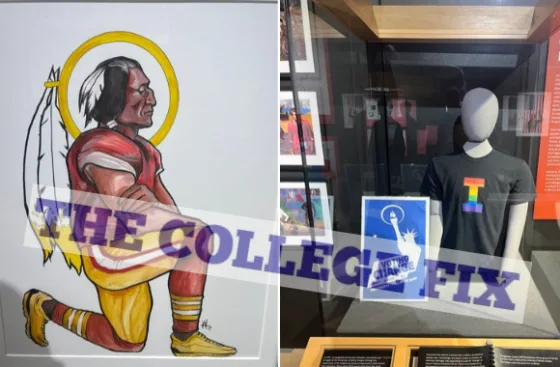
The museum also highlights past activism events on campus, such as a drag performance outfit worn by a student at a graduate employees union protest in 2018.
“Drag is both highly visible and highly political, so I wanted to put together a look that would help GEO stay strong on what I remember being a very soggy day of picketing,” a sign quotes a student as saying.
Several displays were dedicated to honoring protests against the Dakota Access Pipeline and criticized the Washington Redskins football team name.
The Fix emailed the University of Illinois and Spurlock Museum on Oct. 14 and 20. Officials did not respond to the emails or a voicemail on Oct. 22.
The Fix asked about the decision behind the exhibit’s topics and the inclusion of a student protest, such as a drag performance outfit, and any goals to balance political discussion.
Dale Mize, an exhibit curator, told the University of Illinois student newspaper, The Daily Illini, that the Spurlock Museum “wanted to focus on the idea of unfinished revolutions — things that people have fought for in the country over the last 250 years.”
Historians question the educational value of the exhibit
The Spurlock Museum exhibit drew criticism from historian Mary Grabar who told The Fix it is “essentially Marxist.” Grabar, a historian, wrote a book debunking the 1619 Project’s claims about the founding of America.
She told The Fix the whole exhibit sounds “like a lot of agitprop for more protests for a never-ending list of ‘rights,’ which are not rights properly understood but demands from the state.”
“[A] university should be a place of scholarship, not agitation,” she said, and recommended that if the Spurlock Museum wanted to be more accurate, it “should exhibit the result of Marxist agitprop: starvation, mass graves, and destroyed churches that come from Marxist revolutions.”
A University of Illinois law school alumnus and author of “Lies My Liberal Teacher Told Me,” told The College Fix in a phone interview that “there’s nothing wrong with discussing the civil rights piece of American history.”
However, Kentucky State University Professor Wilfred Reilly argues that the problem with the museum exhibit is that “this kind of stuff in practice is one, that it tends to be extraordinarily one-sided to an unrealistic degree and two, that it tends to be presented as the focus of American history.”
An example Reilly gives is “presentation that presents the Indian wars as illogical one-sided brutalism, which is what I see probably 90 percent of the time when I go to museum exhibits and so on.”
Reilly argues: “That’s profoundly unrealistic. And privately, over a drink, I think any social scientist that I work with on the history side would agree with that.”
Another problem Reilly views with the exhibit is the focus on critical theory. Specifically focusing on topics like gay marriage, which he doesn’t have a problem with but doesn’t “necessarily think the gay marriage movement is a top 10 or 20 thing that defined America.”
Instead, topics that Reilly believes should be included in the exhibit would be the “Revolution, winning the Cold War, beating the Nazis, settling the country.”
Reilly then pointed out that if the Spurlock museum applied the same framework to a country like China, it would “present Chinese history just as a series of wars where 30 million people died for nothing.”
On the other hand, Chinese historians “would probably frame that as the Great Wall, conquering the barbarians, fighting the Mongols, the glory of colors on both sides.”