FEATURED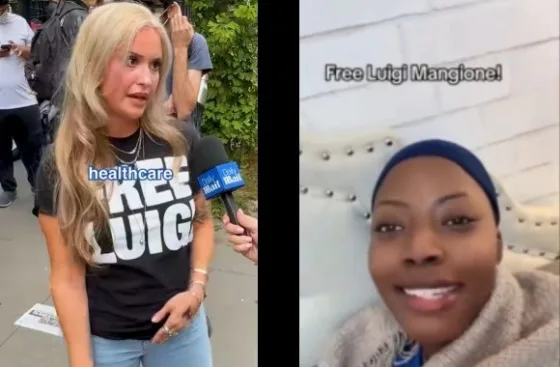
Scholars say alleged murderer is being perceived as ‘Robin Hood’-like hero
Multiple scholars warn that social media could be helping turn alleged murderer Luigi Mangione into a “Robin Hood”-esque figure in light of angst against the healthcare system.
Their warnings come after a new Emerson College poll found a significant minority of young adults appear sympathetic to Mangione. The 28-year-old is on trial after allegedly murdering UnitedHealthcare CEO Brian Thompson in December 2024.
Nearly four in 10 people (39%) between the ages of 18-29 consider Mangione’s alleged murder “acceptable” or at least “somewhat acceptable,” according to the poll published Aug. 20.
Overall, less than 17% of Americans felt the same way.
The “acceptable” or “somewhat acceptable” rate declined with each age group, going from 26% for those ages to 30-39, to 10% for those 50-59, to 6% for those 70 years or older, per the data.
University of Notre Dame Professor Tim Weninger told The College Fix that he’s “not largely surprised” by the number of young adults who are sympathetic to the accused.
“I imagine that many people feel that Mangione represents frustration and they understand why he (allegedly) murdered the executive. A lot of young people feel that he performed a heroic/sacrificial act. And, let’s be honest, it helps that he is a conventionally-attractive young man himself,” he said in an email Friday.
Much of Weninger’s research focuses on “how humans consume and curate information” through social media and artificial intelligence.
When asked what factors could be driving young adults’ opinions on the case, he said his “hunch” is that it’s “a way to express their own frustration,” especially about the current healthcare system.
Approximately 70% of Democrats, 43% of Independents, and 42% of Republicans cited healthcare as the most important issue facing the United States heading into the midterms, according to the same Emerson poll.
“When the social and judicial systems are seen as not representing the people, then this kind of thing can occur,” Weninger said, offering gang violence as another example. “So, people take matters into their own hands.”
Still, he said he doubts that “that many people actually support the overturn of the rule of law.”
His solution is “to strengthen our democratic institutions” so that people can “believe that they can make a difference by working within social and legal processes.”
“This is basic social contract theory,” Weninger told The Fix. “John Locke argued that the only right citizens surrender when entering a civil society is the right to personally punish wrongdoers. In exchange, the government guarantees protection and equal justice. If the government fails to provide that protection, the social contract is broken and we can expect to see more instances of vigilante-justice like the murder of the healthcare CEO.”
Two weeks ago, Mangione pleaded guilty to stalking charges. His trial, originally scheduled for later this month, was postponed. His lawyers have asked a state judge to throw out the remaining charges, including murder, according to Forbes.
MORE: Suspect in UnitedHealthcare shooting ID’d as Ivy League grad with two degrees
Eric Ramirez-Thompson, criminal and justice studies professor at the College of DuPage in Illinois, told The Fix that he was not “entirely” surprised by the poll results either.
“What I find particularly interesting is its stability,” he said pointing to a 2024 Emerson poll that similarly found “41 percent of voters under 30 considered the actions acceptable.”
“That suggests we may be looking at something more durable than an immediate emotional reaction to the case,” Ramirez-Thompson said in an email Friday.
However, he cautioned against “interpreting the finding to mean that nearly 40 percent of young adults simply ‘support murder.’”
He noted that the trend’s cause is “especially interesting” from a criminological perspective because Mangione seems to have become “a symbol through which they express broader grievances.”
“My research on this case found that social media played an important role in shifting the public narrative from one centered on an alleged offender to one in which some people portrayed him as a folk hero or a modern-day Robin Hood,” Ramirez-Thompson said.
Published last October, his paper linked the situation to strain theory, which “helps explain how persistent grievances and negative emotions can shape people’s interpretations of crime and of responses to it.”
“The healthcare system served as an unusually powerful source of shared grievance in this case,” he said. “Many people have personal experiences with denied claims, medical debt, prior authorization requirements, or navigating insurance coverage. Once the Thompson killing became linked to those experiences, the discussion expanded beyond Brian Thompson and Luigi Mangione.”
He suggested that social media “then amplified that process,” and the theory “helps explain how an online community can redefine an accused offender as a protest figure or folk hero.”
Ramirez-Thompson told The Fix that the “most concerning consequence would be an erosion of the moral boundary between legitimate grievance and legitimate violence.”
“A democratic society depends on people being able to criticize corporations, government, healthcare systems, economic inequality, and other institutions very aggressively while still maintaining a fundamental distinction between protest and violence,” he said. “Once violence is viewed as acceptable because the target is an unpopular institution, the same reasoning can be adopted by people across the ideological spectrum.”
Another consequence of this trend is the copycat effect, Seattle University Professor Jacqueline Helfgott told The Fix.
“We are already seeing consequences with many copycat crimes in a short amount of time,” the criminal justice professor said in an email last week.
“Not just people using his rationale for violence to harm insurance companies, but his name is being used as a verb where subsequent perpetrators are committing crimes against other targets – eg calling for ‘Luigi-ing’ Tech CEOs and in other cases (eg the vandalizing of Toronto Speed Cameras) where people are referring to perpetrators of other types of crime …” Helfgott said.
As to what to do about the situation, DuPage college’s Ramirez-Thompson cautioned against resorting to censorship.
Instead, he suggested that institutions take young adults’ “underlying grievances seriously.” He also encouraged “stronger digital and media literacy and more research into how algorithms, online communities, and social reinforcement shape attitudes toward violence.”
He recommended that government officials, law enforcement, and the media be “thoughtful in their portrayal of high-profile defendants” to avoid “strengthening the individual’s symbolic status.”
“The larger challenge is to hold two ideas in tension,” Ramirez-Thompson told The Fix. “We should take grievances about healthcare, inequality, and institutional power seriously, while being equally clear that they do not legitimize interpersonal violence. If we dismiss the grievance, we may deepen the strain. If we normalize the violence, we create a much more dangerous social problem.”
MORE: Accused Charlie Kirk assassin’s case moves forward toward trial