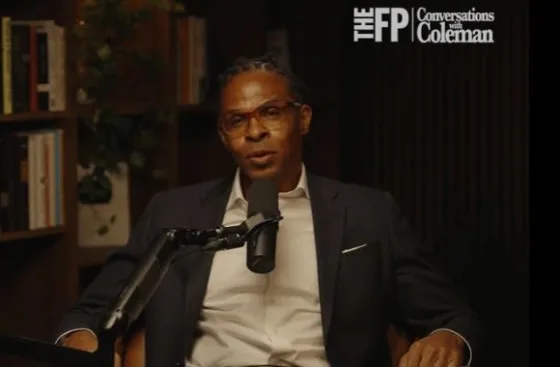
Prize aims to lower cost of ‘tackling tough questions,’ Harvard professor says
A newly launched $1 million academic prize aims to recognize social scientists who challenge prevailing political, intellectual, and methodological views, as concerns about academic freedom and self-censorship continue to shape debates in higher education.
Harvard University economist Roland Fryer told The College Fix the prize was established to encourage researchers to pursue controversial findings without fear of professional consequences.
“We established this prize to lower the cost of tackling these tough questions,” Fryer said.
The Carob Trust Prize for Academic Courage will award $1 million over five years to scholars whose research demonstrates intellectual independence, originality, and a willingness to pursue controversial findings.
According to the Carob Trust’s website, the prize will recognize academics whose work challenges established ideas and has the potential to influence public policy, academic research, or society.
The initiative is associated with Fryer and billionaire investor Bill Ackman, who serves as a trustee of the Carob Trust and funds the prize.
Fryer told The College Fix that his concerns about academic freedom grew after observing students become increasingly reluctant to discuss sensitive subjects.
“I wrote about how I discovered that my students were no longer debating sensitive topics like religion, abortion, or race and gender with one another, for fear of the backlash they would face,” Fryer said.
He added that students have approached him with concerns about whether they should publish research that could generate controversy.
“These students feared that their results would be received as a provocation, that their motives would be questioned,” Fryer said. “They sometimes bury their findings or choose to write on different topics altogether.”
Fryer argued that reluctance to publish controversial findings could ultimately affect public policy by discouraging research on important social issues.
He told The Fix that he has experienced backlash firsthand, pointing to a study he conducted approximately 20 years ago examining whether financial incentives could improve students’ academic performance.
“I was kicked out of the public school system twice. Someone shot the windows out of my house,” Fryer said, describing the reaction to his research in New York.
He said that despite the initial controversy, he now regularly hears from individuals implementing similar incentive programs around the world.
Fryer also raised concerns about ideological trends in academic publishing, saying he examined approximately a decade of research published in leading economics journals.
“Over the last few years it’s two to one progressive over conservative,” Fryer said of the policy conclusions he reviewed.
He acknowledged that the findings could reflect the direction of the research itself but questioned whether editorial decisions or researchers’ reluctance to pursue certain topics could also contribute to the disparity.
“Either journal editors are turning down certain results or people aren’t running the studies,” Fryer said.
In a September 7 Wall Street Journal opinion piece, Fryer and Ackman argued that researchers face professional incentives to avoid publishing findings that challenge accepted views.
“Over the past decade, Mr. Fryer has met with hundreds of undergraduate and graduate students—careful, talented, serious scholars—who came not to discuss what they had found but to ask whether they were allowed to say it,” they wrote.
They also cited a 2024 survey by the Foundation for Individual Rights and Expression, which found that 35 percent of surveyed professors reported toning down their written work out of fear of controversy.
According to the Carob Trust, recipients will receive flexible, largely unrestricted financial support, allowing them to continue their research without extensive limitations on how the award is used.
The inaugural prize, scheduled to be announced in spring 2027, will focus exclusively on the social sciences.
Candidates will be evaluated based on intellectual independence, willingness to challenge established views, and the lasting impact of their research.
The selection committee will consider a scholar’s body of work rather than a single publication. Earlier-career researchers may also be considered for smaller awards.
When asked whether outside funding could influence which research receives recognition, Fryer said the prize would prioritize research quality rather than political ideology.
“This isn’t a prize that rewards contrarians. We are agnostic to what the conclusion is,” Fryer told The College Fix.
He explained that recipients must have produced high-quality research that initially faced hostility but whose conclusions have subsequently been supported by evidence.
“We aren’t rewarding research we hope turns out a certain way, it has to be research that has held up,” Fryer said.
Fryer also emphasized that Ackman, who funds the prize, will not have a vote in selecting recipients and that selection committee members are ineligible to receive the award.
The eight-member selection committee is chaired by Fryer and includes Stanford University political science professor Brandice Canes-Wrone, Vanderbilt University Chancellor Daniel Diermeier, and Brown University emeritus professor Glenn Loury.
Other members include Harvard economist and Nobel laureate Eric Maskin and Johns Hopkins University sociologist Stefanie DeLuca.
Fryer said the committee was intentionally assembled to include scholars with differing political perspectives.
“They don’t share politics. They share an epistemology: that a finding isn’t made wrong by being unwelcome and isn’t made right by being convenient,” Fryer said.
Candidates must be living U.S. citizens or legal residents, and self-nominations are not permitted. The deadline for nominations is November 1.
The Manhattan Institute, a public policy think tank, expressed support for the initiative but clarified that it did not create or support the prize.
“The Manhattan Institute is rooting for the Carob Trust Prize and excited to see it awarded but the Institute cannot claim any credit for conceiving of or supporting this exciting prize,” Leah Thomas, the institute’s director of media relations, told The College Fix.
The Carob Trust’s president, Yael Levin Hungerford, previously led the Manhattan Institute’s Adam Smith Society, according to her biography on the trust’s website.
The Carob Trust describes its broader mission as supporting democratic institutions, individual rights, equality under the law, and the free exchange of ideas.
Fryer said he hopes the prize will encourage academics to pursue research even when their findings challenge widely accepted beliefs.
“Breakthroughs often begin as unpopular ideas,” Fryer said. “By honoring independence, courage, and resilience, we hope to give today’s controversial insights the chance to become tomorrow’s common sense.”