FEATURED
AAUP raises academic freedom concerns while professor says list will improve standards
Under a new core curriculum at the University of Texas at Austin, faculty teaching two required courses must now choose some of their assigned texts from an approved list of 50 authors. The requirement has drawn both criticism and praise.
“UT Austin students will learn to wrestle with important questions about human life, society, science, and technology through a core curriculum based on foundational coursework in the arts and humanities, the social sciences, and STEM,” a report by the school’s Core Curriculum Task Force reads.
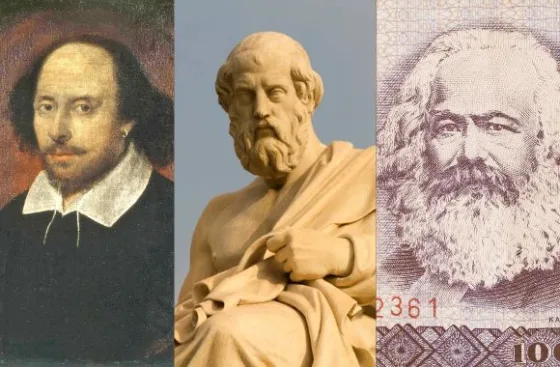
One new course, Great Questions of Human Life, is part of the core curriculum’s arts and humanities pillar, and at least half of its course material will be selected from the curated list. The course features thinkers like John Locke, Aristotle, Plato, and Shakespeare, as well as religious writers such as Thomas Aquinas and St. Augustine of Hippo. Foundational documents like the Constitution and the Bible are also included.
Devin Stauffer, a government professor and chairman of the task force, told The College Fix, “We’re looking for truly the greatest works of the human mind, and it turns out that almost all of those were written over 3,000 years ago.”
He added, however, that there’s no principle that says there can be no living author on the expanded list.
Stauffer explained that the program is still in its pilot year, and that the goal is to incorporate works “of historic importance and artistic beauty, and works that dig at the fundamental questions that the course is about,” rather than focusing on a specific selection criterion.
Stauffer added that the list is set to expand to 100 authors, which could include some suggestions from faculty and staff who have raised objections during the initial pilot program.
“People in Middle Eastern studies asked why the Quran isn’t on the list if the Bible is, and I told them it probably should be on there,” he said.
The expanded plan, which is expected to launch in the spring, will “likely be selected by a broadly formed committee of humanities-focused faculty members from around the university,” though nothing is concrete, he said.
Soon after the proposal was launched, UT Austin’s chapter of the American Association of University Professors told Inside Higher Ed that it was “disappointed and dismayed” by the list of authors.
Calling the list “backward-looking rather than forward-thinking,” the AAUP criticized the selection of authors, saying the list will not help prepare students for living and working in the 21st century.
“UT should allow faculty who teach a course on Great Questions of Human Life to choose the texts that best offer multiple perspectives on the particular questions they are considering,” the group said. “Anything less disrespects both faculty and students.”
However, Mark Bauerlein, a former English professor and editor at First Things, gave a starkly contrasting view of the list compared to the AAUP.
“Given where we are after a half-century of the destruction of the Western canon, and the consequent damage that has been done to the minds of the young, I would rate this a very-very good list,” he told The Fix.
Responding to the AAUP’s criticisms, he said, “The once-noble AAUP has descended into a gaggle of hacks and bigots willing to uphold abominations such as diversity statements in hiring and promotions.”
He called the AAUP’s response “one of the best endorsements of the Texas list that I can imagine.”
“As the professors whine and grumble, remind them that while they have been manning the bridge, humanities majors have plummeted, humanities research has lost its prestige, and the job market has shrunk. When people preside over a catastrophe, we should stop listening to them,” he said.
Bauerlein added that he sees value in the program as a way to address the corrupted standards of the humanities.
“We need more uniformity, more prescription, more canonical orientations of the syllabus,” he said.
Robert Shibley, an attorney with the Foundation for Individual Rights and Expression, told The College Fix that UT Austin’s curriculum is not violating any academic freedoms.
“Universities are free to have core curriculum classes in which they require that students be introduced to certain authors and concepts … it appears that while professors have to select half of their readings from the ‘approved’ list, they are free to assign the other half based on their own expertise,” he said.
He added that these types of uniform programs have existed for years. However, he warned that the new standards cannot be used to indoctrinate students.
“The important thing will be to ensure that a shared core curriculum where students learn about the same topics does not become a thinly veiled effort to propagandize students to all believe the same way about those topics,” Shibley said.
He added that tensions between academic freedom and curriculum uniformity grow as universities try to “micromanage what is taught and how.”