
 FEATURED
Key Takeaways
- The new report from the James G. Martin Center argues there is a significant gap in civics education at the higher education level.
- The report calls for mandatory civics education, emphasizing its importance especially for future teachers.
- Advocates also would like to see a civics literacy test for graduation and education revolving around Constitution Day.
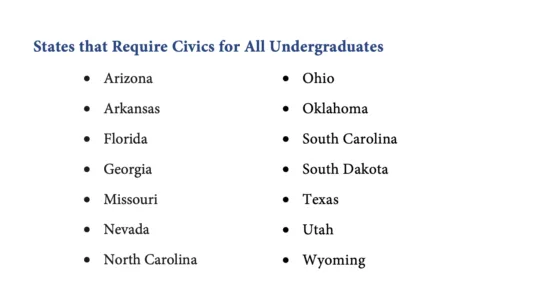
Only 14 states require civics courses to be included in college general education programs, according to a new report by the James G. Martin Center for Academic Renewal released Monday.
The report, “50-State Comparison: Civics Education,” an advanced copy of which was provided to The College Fix, surveyed civics education requirements at the high school and college level. In it, the conservative think tank argues that many higher education institutions have neglected to educate students about American history and principles.
Author Shannon Watkins, who spoke to The Fix via email, believes that requiring civics courses in college would improve the state of civics education in the U.S. The center is a conservative nonprofit based in North Carolina that focuses on higher education public policy reform.
“Statewide requirements help ensure that a greater number of students are learning key American ideas and principles,” she told The Fix.
She went on to say, “A significant first step would be to require all undergraduate students to take a civics course that covers fundamental American documents as part of the general education curriculum.”
When asked what she considers the most significant factors holding back civics education in the U.S., Watkins said some people “do not see the need” for it, especially in college.
“In other cases, there is disagreement about which content is important for students to study in college,” she said.
The report also proposes enhancements to the required curriculum at the college level. Watkins said a “significant first step” would be teaching the “fundamental American documents as part of the general education curriculum.”
Another recommendation is to create a civics literacy test that students must take in order to graduate. Watkins told The Fix that, in doing so: “Institutions could consider using the U.S. citizenship test as a model for civics literacy assessment. Doing so would help gauge students’ civic knowledge.”
In addition, the report recommends regular civic knowledge surveys, which would inform college leaders about the gaps in students’ civic knowledge.
It also noted that while most states require a civics course for high school graduation, few require future teachers to study civics in college.
Watkins said she believes “it is crucial for future teachers to be well-versed in civic knowledge. Teachers cannot pass on what they do not know.”
In the report, she recommends that all future teachers be required to take a course on American history or politics.
The report also emphasizes the importance of fostering a deeper appreciation for the Constitution by observing Constitution Day every Sept. 17, and developing programs that teach students the importance of the First Amendment.
Jenna Robinson, the president of the Martin Center told The Fix, “As we approach the 250th anniversary of the Declaration of Independence, it is more important than ever that students understand our constitutional government and civic traditions.”
Jeffery Collins, interim director of the University of Florida Hamilton School for Classical and Civic Education, agrees that American civics education is in a “woeful” state.
“The main problem with civics education at US universities is that it barely exists at many institutions. The relevant departments – history, politics, philosophy – have all too often abandoned the subjects and fields that constitute the subject,” he told The Fix when asked about the report.
“We often hear complaints about the increasingly one-sided political orientation of universities, and that is a real problem,” Collins said. “But the bigger problem is the euthanizing of whole fields because they are deemed too traditional, or ‘Western’, and so forth. This has been profoundly damaging.”
However, Collins expressed skepticism at the idea of a “blanket” civics requirement for all teachers, noting that many specialize in specific subjects.
But “for those who will be teaching American history or civics one would certainly want them taking more than just one course,” he said. “Teacher training is at times too focused on pedagogical technique and not enough on content.”
He believes the real issue within K-12 education is that, “for some decades there has been an enormous emphasis on testing students in math and literacy. History and civics are not tested in the same manner, and so have languished as subjects. If the subjects are marginalized, fewer teachers will seek the training, and a cycle is established.”
Collins also commented on the center’s suggestions of curriculum enhancement and civics testing, saying the effectiveness “would depend to some extent on the quality of the civics courses offered and the quality of instruction in them. You really need to get your best faculty into such core curriculum, and that can be challenging.”
Editor’s note: This report has been corrected to say 14 states require civics courses to be included in college general education programs.
MORE: Georgetown scholar on how to pick ‘a college amidst an educational crisis’

