FEATURED
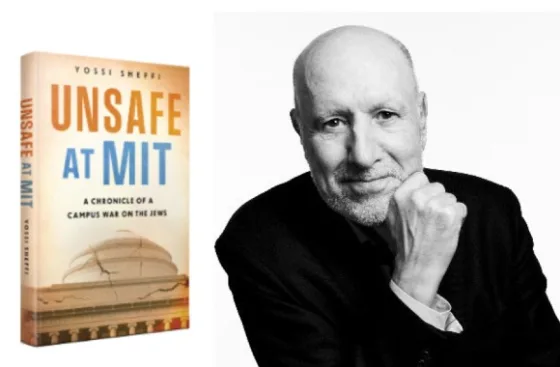
Engineering professor says he was told to work ‘solely’ on his field of study, not ‘issues of antisemitism’
An engineering professor at the Massachusetts Institute of Technology says he is facing backlash from the administration after publishing a book detailing how the university “failed” Jewish students.
The book, “Unsafe at MIT: A Chronicle of Campus War on the Jews,” highlights the “lack of protection of Jewish students” on the MIT campus after the Oct. 7, 2023 Hamas terrorist attack on Israel, Professor Yossi Sheffi told The College Fix in a recent interview.
Simultaneously, the book aims to “hold to account an administration that refused to acknowledge its failures,” Sheffi, who was born in Israel, wrote in a recent op-ed in The Free Press.
In addition to writing about what he had personally seen happening on campus, Sheffi interviewed dozens of Jewish and Israeli students and faculty members about their experiences for the book. His writing recounts the “hostility and intimidation” that many faced in the days and months after the terrorist attack.
Incidents ranged from small day-to-day interactions to a 2025 commencement speaker using her platform to push the pro-Palestinian cause — a situation that attracted national news coverage from outlets including The College Fix. A prominent computer scientist also resigned from MIT in 2024, citing concerns about antisemitism.
Sheffi also noted numerous students who simply left the university due to a lack of comfort on campus post-Oct. 7.
“I was hoping – not really expecting, but hoping – that the administration would say ‘Ok, this is something like a truth commission … you actually document exactly what happened, so let’s stop saying that it didn’t happen,’” Sheffi recounted in a recent phone interview.
Unfortunately, he said that was not the case after the book came out in July.
Sheffi is the author of nine previous books on supply chain strategy, urban transport, and logistic networks. For the advertising of his past publications, he said he used funds provided by MIT. However, when it came to doing the same for “Unsafe,” his funding was threatened, he said.
“The provost even threatened to claw back the funds I used to publish my previous books over the past 20 years, even though they had no issue with those books at the time,” he wrote at The Free Press.
When he questioned university leaders about it, he said he “received only a reference to an unrelated rule and an email from the chair of the faculty stating that, after some investigation, he found that Brown and Yale had imposed some restrictions on book advertising. When I asked him how those rules applied to MIT, I received no response.”
As explained in his op-ed and to The College Fix, the money was not the main issue but rather what the situation signified. Throughout this entire process, Sheffi pointed to examples of limitations on his academic freedom and hypocrisy within the administration.
“Shortly after my book was published, I was told by the dean of engineering that I was expected to work solely on operations research and supply-chain management, rather than issues of antisemitism,” Sheffi wrote in his Free Press op-ed.
“Academics, of course, routinely write and speak about subjects beyond their specialties; did MIT ever penalize linguistics expert Noam Chomsky when he started denouncing the war in Vietnam and other aspects of U.S. foreign policy? That’s called academic freedom. There’s a blatant double standard when such a limitation is invoked only in a case like mine—a Jewish professor telling the truth about the treatment of Jewish students,” he wrote.
Additionally, he told he told The Fix that MIT “fights the Trump administration on academic freedom all the time, and now I’m a senior professor of 51 years at MIT and you are telling me what I can and cannot do academically, what books I can and cannot write?”
When asked about Sheffi’s situation, MIT spokesperson Kimberly Allen told The Fix via email that the university “encourages and expects independent thinking from all members of its community and, as a general practice, does not comment on the freely expressed views of any individual.”
“At the same time, MIT’s leaders look back at the time the book describes and recognize the anguish and struggle members of our community experienced. The Institute has made great strides since then and remains committed to this important work,” she said.
Allen cited findings from the institute’s 2026 Quality of Life survey that found over 90% of undergraduate and graduate Jewish students reported feeling “satisfied” at MIT.
Sheffi has worked at MIT for over half a century, and in his time there, has been honored with recognition as an Elisha Gray II Professor of Engineering Systems and has built up a research center at the university from a volume of $200,000 to $26 million, according to his bio.
As a tenured professor, Sheffi plans to continue his work at the university, regardless of the tension between himself and university leadership.
“They continue with their restriction and I continue with my publicity campaigning,” he said.
“I hope that my personal example will tell people they can stand up to the hate,” Sheffi said. “They can just stand up, don’t just take it lying down. Don’t just accept it.”
MORE: Harvard, Stanford, MIT get Fs for addressing antisemitism: report