
 FEATURED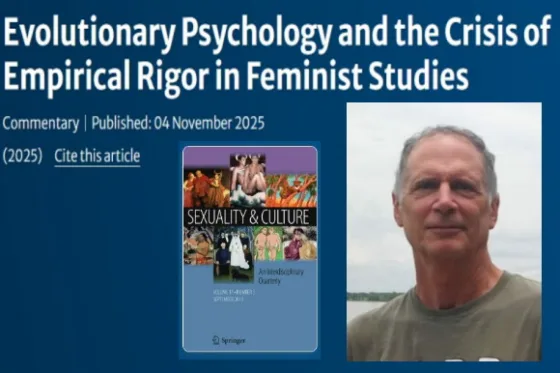
By day, he studies volcanos. But a decades-long scholarly side-hustle and intellectual passion of University of South Florida geologist and geochemist Marc Defant has led him to recently publish a scholarly journal article calling feminist studies out as something akin to academic fraud.
“Feminist studies operates more as an ideological platform than an academic discipline,” wrote Defant.
The field, he wrote, “has arguably evolved into an intellectual hub for political ideologies, which should raise concerns among not only scholars but taxpayers about the infiltration of partisan perspectives within the university system.”
Published November in the academic journal Sexuality & Culture, Defant argues the field of feminist studies has come to rely on “untested concepts like patriarchy and toxic masculinity” while rejecting “biological and evolutionary evidence” and showing a preference for “political advocacy over scholarly rigor.”
Moreover, Defant argued, several topics often researched by feminist studies scholars, such as the nature of gender, the objectification of women, and the etiology of rape, are best left not to feminist studies scholars, but to evolutionary psychologists and other researchers examining these questions through a more biological lens.
Speaking to The College Fix in a telephone interview earlier this month, Defant said he wrote his review paper out of a frustration with regularly seeing a denial of evolutionary psychology in feminist studies.
In debates on topics such as the nature of gender, Defant said, he “really can’t find much in the way of an argument, a succinct argument, posed by feminists against evolutionary psychology.”
Instead, he said, feminist studies scholars seem to just outright reject “evolutionary psychology and then go on [about]…patriarchy and social constructionism.”
‘An awakening’
As a geologist and geochemist by training, Defant told The Fix, his background is sometimes used against him by his opponents, but he dismisses such criticisms, emphasizing he has developed a comprehensive understanding of evolutionary psychology through extensive reading in the area over the past 30 years.
For much of his life, Defant said, he has had an interest in social and behavioral differences between the sexes and has often pondered questions like why men place so much value on physical attractiveness when choosing romantic partners while women place a similar weight on a man’s ability to make money.
Then, in 1994, after roughly a decade into his career at the University of South Florida, Defant said he came across journalist Robert Wright’s book, “The Moral Animal,” which sparked his interest in evolutionary psychology.
It led him to prominent works by biologists like Richard Dawkins and E. O. Wilson, who similarly wrote about the role of evolution on behavior.
“When I came across evolutionary psychology,” Defant said, “it was like an awakening.”
‘There was a distinct effort to silence me’
At the core of evolutionary psychology, Defant wrote in his article, is the fact that there is a “disparity in reproductive investment: males produce abundant sperm and can father multiple offspring in a short time, whereas females produce a limited number of eggs, endure pregnancy, and typically shoulder the primary responsibility for raising young.”
This disparity, Defant noted, can help explain many of the social and behavioral differences seen in males and females.
Subsequently, Defant told The Fix, he tried to share his burgeoning enthusiasm for evolutionary psychology with his students once his interest in it began to develop, soon incorporating it into the honors science course he taught throughout much of the 1990s.
However, Defant said, this led to a certain amount of tension between him and university administration, recalling, “There was a distinct effort to silence me.”
“I remember our dean of the college at the time claiming that I was harming the children and they needed to protect the children, meaning the students,” said Defant.
Later, in 2001, Defant said, he was removed from his position teaching the honors science course at his institution, but was allowed to continue teaching and doing research in the geology department, which he did.
Yet, Defant said, he never gave up his interest in evolutionary psychology, and, while undergoing a recent post-tenure review, managed to secure his administration’s written approval to address questions pertaining to evolutionary psychology more publicly.
Currently being in a much different place in both his life and career, Defant said this also makes such pursuits easier, noting that if he is forced out of his job, he can just retire without having to worry about how to provide for his children, who are now grown.
Intellectual imperialism?
Since the publication of his Sexuality & Culture article, Defant noted he has received some push back from feminists on his campus, although nothing too nasty.
Also, Sexuality & Culture published a response paper to his article penned by Cordelia Fine, a University of Melbourne professor who studies the history and philosophy of science. In her response paper, Fine accused Defant of engaging in intellectual imperialism, as well as putting forth “simplistic and partisan treatments of complex gendered phenomena.”
In a later email to The Fix, Defant wrote Fine’s critique “relies on a familiar pattern: evolutionary explanations are treated as inherently suspect, feminist explanations as morally necessary, and any attempt to bridge biology and social outcomes as a kind of intellectual trespass.”
Defant also submitted a more detailed response regarding Fine’s critique to Sexuality and Culture.
However, when speaking with The Fix, Defant said, the responses he has received regarding his initial Sexuality & Culture paper have been largely positive, noting that evolutionary psychologists who have contacted him have been pretty encouraging and that the publication of his article has opened doors in the form of invitations to write papers on related issues and appear on podcasts.
MORE: ‘Feminism is the most self-defeating movement of our time,’ says cultural critic

