
 FIX EXCLUSIVES
Key Takeaways
- The Conversation is a news organization partially funded by public universities to the tune of $2 million annually while producing predominantly anti-Trump content.
- None of the articles analyzed by The College Fix were explicitly supportive of Trump, and the language used in many instances was deemed emotionally charged and biased, raising concerns about the publication's claim of neutrality.
- Public universities, including Michigan State and West Virginia University, financially support The Conversation, but inquiries to these institutions about their contributions and the political alignment of the outlet went unanswered.
A news site that promises “academic rigor” with “journalistic flair” has received millions of dollars from public universities while regularly running anti-Trump articles.
The Conversation is a decade-old news site that aims to take academic research and turn it into understandable news stories. It has a wide reach, explaining on its website that “the Associated Press distributes our content daily to thousands of newsrooms.”
However, while promising a “fact-based and editorially independent forum, free of commercial or political bias,” research by The College Fix shows that about half of the website’s coverage of Trump is negative with little to no positive. This coverage is underwritten by universities, many of them public, collectively contributing more than $2 million per year. For the latest fiscal year, this represents about 25 percent of the outlet’s funding.
The Fix reviewed 53 articles about President Donald Trump between Jan. 9, 2025, as he prepared to return to the White House, and Feb. 14, 2025. About 60 percent of the articles were considered negative toward Trump and none were explicitly positive.
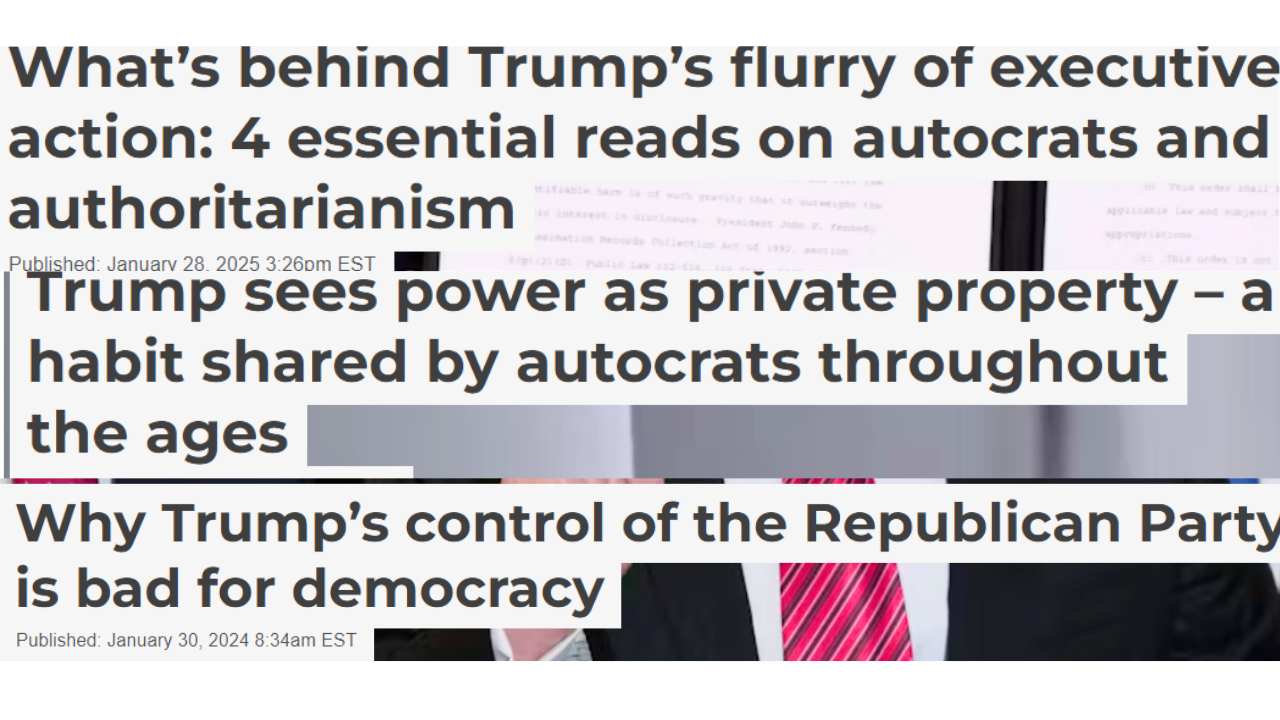
The methodology involved close readings of each article, specifically looking for emotionally charged language that indicated a particular stance. Words like “dictator,” “authoritarian,” “bully,” or “fascist,” or direct comparisons of Trump to these concepts, were flagged as indicators of explicitly negative bias, moving beyond neutral journalism.
In fact, The Conversation itself highlighted its role on Jan. 28 of this year in educating the public about how “autocrats” operate, in reference to Trump.
“The Conversation U.S. has published several articles – many from Donald Trump’s first term as president – that spell out how autocrats, and those who want to be autocrats, behave and why,” Editor Jeff Inglis wrote, along with comments from six professors. The website does regularly run articles that compare Trump’s actions to authoritarianism.
Articles were considered neutral if they generally kept an academic tone and focused on fact-based criticism of Trump’s policies. For example, while a story in February criticized Trump for tariffs and not controlling inflation, it did not make a moral judgement or imply sinister motives behind his actions. Another neutral article analyzed the possible legal and logistical problems of getting rid of the penny, as Trump has suggested.
The Fix did not identify any articles in support of Trump’s policies during this time period.
When The Fix asked The Conversation’s executive editor, Beth Daley, for comment on the results of the study, she responded, initially seeking clarification regarding the selection of the 53 articles. After receiving the list of analyzed articles and the applied labeling (fair or negative), Daley’s subsequent response requested the methodology and criteria used for the study prior to commenting on The Fix’s initial questions.
Regarding publication’s funding, Daley confirmed that “The Conversation U.S. is a nonprofit organization, with its funders (universities, foundations, individuals) listed on its website.” She also said the publication has a commitment to “editorial independence” and a “non-partisan mission,” and it is “always open to feedback and regularly review our practices to ensure we uphold our standards.” She did not directly answer a question about how much money comes from universities and any specific efforts to solicit center-right viewpoints.
The Fix clarified Daley’s questions on the criteria and methodology used for the study, however she did not provide a further response over a week later.
The Fix also sent inquiries to several public universities located in predominantly conservative states, identified as funding partners of The Conversation. These universities included Boise State University, the University of Florida, Auburn University, Florida International University, and Georgia Institute of Technology.
Questions to the universities aimed to understand the universities’ financial contributions and their perspectives on supporting a media outlet whose content might not align with the political views of the majority in their regions. None of the contacted universities’ media teams responded to the inquiries within the past several weeks.
The Fix obtained the donations records for Boise State University and Michigan State University via a public records request. West Virginia University sent The Fix a government spending database that provided further information. A public records request with Arizona State University remains pending.
In 2025, Michigan State University and West Virginia University contributed $45,000 each. In 2024 and 2023, all three universities contributed $40,000 each. The provided data shows a payment of $40,000 from Boise State in early 2023.
In total, The Conversation reported receiving more than $2.6 million in membership fees on its Fiscal Year 2024 Form 990. There are 52 public universities listed as members on the website. If each paid $40,000 in 2024, that works out to about $2.1 million alone.
While only a few universities provided membership fee information, the $35,000 to $45,000 range appears to fit with the total amount of program revenue listed on the form 990, as there are about 90 different university members.
Founding members also get special benefits for their professors, including priority review for publication, according to a contract obtained from Michigan State University.
The Conversation similarly reported around $2.6 million in program revenue, meaning university fees, in FY 2023, and $2.2 million in FY 2022, according to public records.
Media expert says website should ‘avoid abstract and hostile language’
A journalism professor who regularly writes about media bias said that while The Conversation provides a benefit, it needs to consider how it covers issues.
Depauw University Professor Jeffrey McCall said, “The Conversation plays a role in the journalistic sphere by providing a platform for college and university analysts/commentators who don’t write for traditional media outlets.”
“In theory, this is a helpful avenue for ideas to get from the academy to the general public. But given the supposed non-partisan philosophy of ‘The Conversation,’ it would behoove them to provide a balanced range of input and perspectives, and to avoid abstract and hostile language such as ‘fascist’ and ‘bully,’” McCall said.
He said The Conversation should review The Fix’s findings and “seek clarification if needed.”
“Getting external critique is generally a healthy thing for any platform, so the people at ‘The Conversation’ should be interested in your project’s results,” McCall said. “It would help ‘The Conversation’ look into possible groupthink within its organization.”
That all the writers are professors may explain why the news organization says it is nonpartisan while generally being against center-right viewpoints, McCall said.
“Any bias at ‘The Conversation’ is a reflection of the mindset held today on most college campuses. That doesn’t excuse any possible bias, but it would seem to explain it,” McCall said.
The website “should strive to live up to its stated mission of being non-partisan,” the professor said.
“If it can’t do that with a straight face, it should rebrand as a left-of-center news outlet and transparently acknowledge to the public its true mission.”

