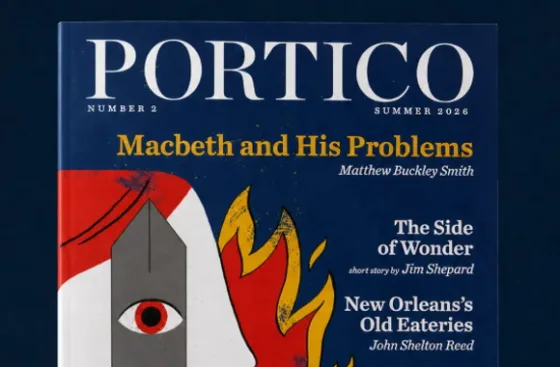
The venerable conservative religious journal First Things has launched a new quarterly literary publication that aims to explore and promote beauty, literature, and art in the face of today’s highly politicized climate.
Portico will publish writing “of the highest quality on topics of artistic and literary significance to contribute to a renewal in the arts,” according to its website. The second printed issue came out earlier this month.
Within its covers, professors, authors, poets and other scholars offer up an ode to “The Norton Anthology of English Literature,” a journey through Rome, a book review of “Homer Haunted,” and a deep dive on Polish philosopher Leszek Kołakowski, among other topics.
Published by the nonprofit Institute on Religion and Public Life, Portico includes original artwork, essays, a short story, poetry, and book reviews. The editor is Micah Mattix, a writer who has taught at Regent University, Yale University, and the University of North Carolina at Chapel Hill.
“Mark Bauerlein writes in ‘Saved by the Norton’ that the order of The Norton Anthology of English Literature provided his own life with purpose when he was an aimless student at UCLA. In ‘You Are Not the Only One,’ Peter Tonguette explores how rereading Anne Tyler’s novel The Accidental Tourist helped him to see his relationship to his parents in a new light,” Mattix wrote to his new readers.
When announcing the new magazine, First Things argued that many literary publications have shifted away from exploring shared cultural ideals and have instead become increasingly driven by political dogma. Portico aims to counter that trend.
“My sense is that people are tired of the politicization of everything,” Mattix told The College Fix.
Instead, he said in an email, the publication hopes to explore the human experience, “to show what life feels like — that is, what it feels like to love and lose, hope and fear.”
One goal is to return the focus of arts and literary magazines to art and literature themselves.
As Mattix put it, Portico will not focus on “the politics of literature and art” but cover literature and arts “directly.”
As First Things had announced: “As more institutions turn against beauty and feed our collective addiction to politics, institutions like First Things must assume a greater responsibility for providing an alternative.”
An essential piece of creating an alternative, Mattix said, is for art to take religion seriously. Portico’s “about” page states it takes “religious faith seriously and has a high view of tradition and freedom of expression.”
“All great writing – all great art – is religious in a sense,” Mattix said. “Beauty is important to us [and] we hope to avoid canned religious language in discussing the writers and artists we admire.”
Historian Wilfred McClay, author of “Land of Hope: An Invitation to the Great American Story” and member of the Portico advisory committee, touted the importance of Christianity’s involvement in the arts throughout America’s history.
The church should return to “a creative intellectual force in the culture,” he told The Fix. Yet, McClay acknowledged that many religious and cultural conservatives are more comfortable critiquing culture than creating it.
Agenda-driven art is “not likely to be successful,” and Portico follows a different path, the historian said via email.
Christopher Scalia, also on Portico’s advisory committee, echoed the notion, saying conservatives often “tend to prefer preserving past great art over pursuing new work.”
Scalia points to a widely held assumption in the culture that “the creative impulse” is something inherently “radical or progressive.”
“That’s nonsense,” Scalia told The Fix in an email. “Conservatives should both preserve the best of the past and create new work.”
McClay similarly argued that “a healthy relationship with the past is essential to fresh creativity,” citing what Christian author C.S. Lewis called “the baptized imagination,” in which art remains faithful to imaginative expression while being inspired by religious truth.
For Scalia, beauty is central to a healthy culture: “A healthy culture produces beautiful things, because beauty is closely related to truth.”
Editor of First Things, R. R. Reno, put Portico’s purpose simply: “The world can never have too much beauty.”
MORE: From war strategy to ‘love and friendship,’ civics schools expand programs as interest grows