FEATURED
Poll: Only 2% students feel like they don’t belong on campus due to their political views
A recent survey from Gallup and the Lumina Foundation has some scholars questioning its methodology after the results found little concern among students about free speech and open dialogue on college campuses.
Titled “The College Reality Check: What Students Experience vs. What America Believes,” the February survey asked thousands of college students and college graduates about open dialogue and their sense of belonging on campus, and broke down the results by political affiliations.
The polling groups concluded that “polarization on campus is a public concern,” but “not a student reality” based on the results, according to a Gallup news release. Students don’t “report widespread limits on free speech,” the polling group wrote.
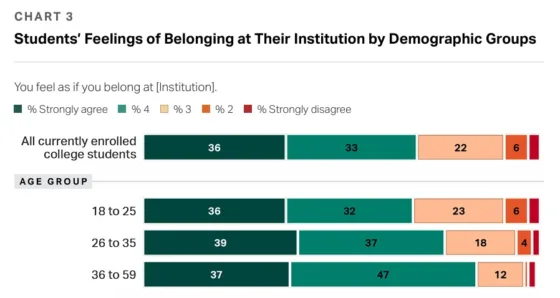
In the survey, 2% of students, including 3% of Republicans, said they feel like they don’t belong on campus due to their political views. Additionally, 69% of Republican and 76% of Democratic students reported they feel free to express their opinions on campus.
Meanwhile, approximately “seven in 10 students, regardless of political party, feel they belong on campus and say their institution facilitates open dialogue,” the survey found.
The results do not align with adults’ perceptions of higher education, according to the survey.
It went on to cite polling that found “nearly one in four U.S. adults continue to express significant reservations about college.”
The poll found 42% of adults said they are confident in higher education, while 23% expressed little to no confidence in the institutions.
Of those who said they have little to no confidence, 38% respondents said they believe colleges promote indoctrination, allowing “faculty to push personal agendas or create ideologically biased environments,” according to the survey.
The adults who were confident in higher education cited aspects such as the “value of being educated,” “the benefits of being taught critical thinking and exposure to diverse viewpoints,” “the quality of American higher education,” and “the opportunities having a degree creates,” according to the survey.
The adults’ responses showed noticeable differences between political parties, with 61% of Democrats being highly confident compared to only 26% of Republicans, it noted.
Overall, the survey results raise the questions: why is there a disconnect between the public’s thoughts and students’ experiences of higher education, and why do the results conflict with other surveys of students’ views on free expression?
Several experts expressed concerns about the methodology and the overall set-up of the survey.
Sean Stevens, chief research advisor for the Foundation for Individual Rights and Expression, said in a recent email to The College Fix that “the use of the agree/disagree format for the response options can result in acquiescence bias – more people saying they agree with a statement than would occur if alternative response options were presented (e.g., does not describe my experience at all to completely describes my experience).”
Stevens also noted the fact that the survey only labeled and emphasized “the scale endpoints,” meaning the participants who chose “strongly agree” or “strongly disagree” (pictured below) and not those who chose answers somewhere in the middle, such as moderately or somewhat agree.
“There is no way to know what each person taking the survey has in mind for these options as 2 could represent X for one person and Y for another,” he told The Fix.
FIRE’s own annual free speech and censorship research on campuses around the nation consistently finds the opposite results.
“After six years of surveying almost 300,000 college undergraduates nationwide, a sobering picture has emerged: students are reluctant to speak their minds, especially on controversial political issues,” the campus legal group wrote in its 2026 College Free Speech Rankings report.
“Many report that they self-censor regularly, avoid certain topics entirely, and doubt their administrators would defend free expression if controversy struck,” the report states.
Samuel Abrams, a professor at Sarah Lawrence College and senior fellow at the American Enterprise Institute, also expressed concerns about the methodology of the Gallup survey in a recent article on FIRE’s Expression substack.
The survey was “measuring the wrong thing,” Abrams wrote. The way the questions are worded focuses more on the professor’s treatment and overall culture of the classroom as a whole, rather than the entirety of the college or university campus, he wrote.
He also pointed to the influence of peer pressure and other factors on students’ perceived freedom to speak, and noted that open dialogue is “not the same as free speech.”
“…the invitation to speak and the freedom to speak are not the same thing, and that on most campuses, one has been systematically undermining the other for a very long time,” he wrote.
Abrams pointed readers to FIRE’s 2026 report, which he described as “a substantially larger and more methodically rigorous sample,” due to its outreach to far more students and different ways of posing questions.
FIRE’s survey found a differences in self-censorship between Republican and Democratic students, finding an unequal burden often falls on Republican students (34% versus 15% for their Democratic counterparts).
The Fix also contacted the media relations offices at Gallup and the Lumina Foundation by email and website contact forms twice over the past week, asking about the critiques of its methodology. Neither responded.
MORE: Free speech group defends U. Illinois College Republicans amid uproar over ICE post