FEATURED
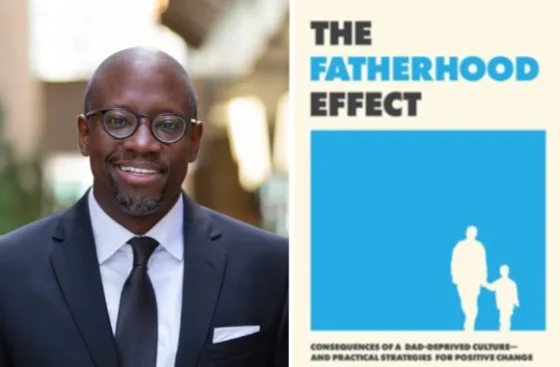
Professor Anthony Bradley says book comes out of his experiences teaching, working in juvenile justice
After 23 students were arrested in just three days at Southwood High School, the violence left the Louisiana school’s leaders with no choice: something had to change.
A group of 40 fathers formed “Dads on Duty,” and took shifts spending time at the school. They weren’t experts in counseling or de-escalation. They were simply fathers who showed up for a whole high school. And as a result, there were no more incidents.
It is episodes like these that epitomize the importance of good fathers, says Anthony Bradley, a distinguished research fellow at the Acton Institute and a professor at Kuyper College, a private Christian college in Michigan. He teaches interdisciplinary and theological studies.
His new book, “The Fatherhood Effect,” is scheduled for release later this month. In it, “Bradley makes the case for the indispensable roles fathers play as foundational pillars in both family and community, and offers a practical path forward,” according to the book’s description.
He recently spoke with The College Fix about the centrality of good dads to the thriving of children — particularly in their education.
The College Fix: What inspired you to want to write this book?
Bradley: This book is really the convergence of two main streams. One is teaching students for almost 30 years at the high school level, the college level, and the seminary level. The other is also working in the juvenile justice space for a number of years as well. And one of the things that’s been consistent for the last, at least 20-25 years is that girls are thriving and young men are struggling.
As I got curious about why that was, and I began to dig in the data, it ultimately came back to family structure — in particular the role of fathers. What the research basically shows is that the closer children feel to their fathers, the more likely they are to have success in multiple areas, including academic success, emotional thriving, faith, transmission from childhood into adulthood, and so on.
Fathers really are the secret sauce for children thriving.
TCF: Do we have a crisis of fatherlessness? If so, how did we get here?
Bradley: If you look at all the data right now, boys are trailing girls in every single grade level, and every subject, in almost every single school in America. Young men are no longer going to college in numbers like they used to. So about 60% of all college freshmen are women. We have an estimated 6 and 7 million men who are not working right now, and they’re not in the trades, they’re not in school — they’re doing nothing. We also have a pretty massive spike in terms of suicide and young men, particularly ages 15 to 24. And when you add all these variables together, we have a crisis.
More recently, thanks to the proliferation of discussions across the political and social spectrum, finally everyone’s talking about this crisis.
TCF: Why does society seem not to care about fatherlessness?
Bradley: For the last 30 or 40 years, thanks to a lot of progressive ideas, fathers have been ignored as a central part of what makes family life work.
If you look at a lot of television shows and even movies, fathers are often portrayed as aloof, as incompetent, as silly. For the last 30 or 40 years, American society has basically assumed that the father is irrelevant. We focus primarily, if not exclusively, on the role of a mother. And there is this very general consensus that the most important parent in a family is the mother. And fathers have been ignored and discounted, even though the research says the exact opposite. It’s really unfortunate.
A lot of the poverty programs that emerged out of the 1960s to support single moms — which is a great thing to support — completely discounted the need to support fathers. In the welfare programming of the late 1960s and early ’70s, the federal government assumed the role of a father. And there were actually some programs that would discourage women from getting married. Women could potentially lose their welfare benefits and even their public housing if a man was discovered in the house. So there were all these perverse incentives to discourage marriage and having a man in the house.
TCF: Are there any overreactions to the problem of fatherlessness that we may need to make sure we don’t drift into?
Bradley: One of the things that we’re seeing right now is the elevation of the discussion about fathers, but what’s being eclipsed is the importance of marriage. The research shows is that the best dads, the healthiest dads, the fathers who thrive the most, the ones who are the most invested in their children, the ones who are most attached to their kids, the ones who are most spiritually and physically and emotionally available to their children are married dads.
What we do not want to do is eclipse fatherhood from the institution of marriage because what makes a really good dad is having incredible support from his wife, but also living in the home and being involved in the regular rhythms of family life and with his children as well.
One way to think about it is that the best fathers are going to come out of very strong, loving, and supportive marriages. And insofar as marriages are strong and thriving, we can also have, by extension, thriving fathers as well.
TCF: You say in your book, “Children who live with their dads do better in school.” Why is that?
Bradley: There are a few things that support that data. Number one, children typically get excited about the things that their fathers are excited about. So if their fathers read a lot, the kids will read a lot. If their dads are into math, the kids will be into math. Children tend to mimic what their fathers do. When fathers show interest in education, it really gets contagious.
Fathers also have an incredible impact helping children regulate their emotions and impulsivity and learn self-control. And what’s really interesting is that this educational impact is primarily learned through play. So when fathers physically play with their children, when they wrestle with them and run around the yard, they actually are teaching their children to control their impulses.
Children also learn empathy, and they learn to love other people. They learn to be other-centered. And these are all pro-social characteristics and values that allow children to thrive in an educational environment. So the father’s role is really, really critical. Fathers doing that in the home is one of the most predictive ways that we can account for children thriving in those areas.
What we know is that the children that do have behavioral issues, the children that do struggle academically, the ones that have underdeveloped brain function and mental capacity — they are much more likely to come from a fatherless home.
TCF: How does a father who isn’t much of an academic or studier be involved in his kids’ education?
Bradley: You don’t have to be an expert in algebra, or biology, or physics, or American history. You just have to, as a dad, show interest in the subject that your kids are studying.
One of the best ways to do this is to ask your kids about what they are learning. Have them teach you, have them show you what they’re doing and ask them questions about what they’re learning. Show curiosity about the subject matter and their child’s performance. Not just their grades.
They need to be present and they need to be curious: present in the lives of his kids in terms of their learning, and curious in showing interest in their subject matter. This will really do a great deal to facilitate their child’s interests in the subject matter and also their performance.
TCF: Is there anything in our education system that exacerbates the fatherlessness problem?
Bradley: One of the things that happens is that in the current education system, when there’s a problem, often the default parent that’s contacted is the mother. And what a lot of school districts are now discovering is that you need both parents involved in all of the conversations and discussions with children.
A lot of schools are actually developing unique programs to get more fathers on campus, to be visible, to be present. and to be engaged in the lives of children. Schools need to do a better job of providing opportunities for fathers to be involved, just as much as mothers are.
TCF: Do our schools properly value the emotional and social soft-skills you mentioned earlier?
Bradley: Our schools right now don’t understand, particularly for boys, how those skills are developed, and so boys get punished for not acting really naturally in some of those ways, which is one of the reasons why many boys started to get discouraged about school. Most educational environments right now are actually for girls. And the role of fathers and the way in which boys are cultivated in those environments right now are really ignored.
One of the things that we’ve really got to do is help schools understand the importance of the father’s role in cultivating some of those social and emotional skills in schools. One of the fallacies is that these types of skills — these social skills, these emotional skills — can be taught in a classroom. Social and emotional learning and having good mental health — all of these sorts of things are actually learned at home.
What schools do, which is highly unsuccessful, is believe that they can simply lecture children into having very, very good social and emotional skills. These are things that children primarily experience through the relationships they have at home. Then they come to school and they practice at school what they experience at home. If home is a place of anxiety and depression and violence and stress, when kids go to school, they will act out in ways that are aggressive and violent.
Some might argue that schools have been quite arrogant about the impact they can have on kids. What a lot of schools wrongly believe is that the kids belong to them. There are all sorts of education theories that have promoted the idea that moral education happens at school. And the research, of course, has suggested the absolute opposite.
TCF: What is the impact that a present father can have on girls in school, too?
Bradley: What the research shows is that when girls feel close to their fathers, they perform better in math and science. A girl’s aptitude in STEM related fields is distinctly correlated with how attached they feel to their fathers. We also know on the behavioral side that girls who feel attached to their fathers have a greater sense of self-confidence, which means that they are better protected from bullying.
Girls who feel very close to their dads are less likely to be influenced by the content on platforms like Instagram and TikTok and Snapchat. We also know that girls who are close to their fathers, particularly in middle school and high school, are much less likely to struggle with anxiety and depression. We also know that girls who feel close to their fathers are much more likely to engage in sexual promiscuity.
For girls, attachment to fathers is profoundly correlated with their thriving, both academically and also socially. It actually grounds their central nervous system. They are free to study well, and they’re also free to navigate the challenges of social life while they are in school, because they’re confident that their father adores them and loves them and cares for them.
TCF: What does society need to do to remedy the problem of fatherlessness?
Bradley: First, fathers need to know how important they are to the lives of their wives and their children. In my experience, most dads have no idea how important they are.
Secondly, fathers need to be supported in terms of their mental health and personal struggles. They need to be supported in terms of helping them manage all the challenges of marriage and family and work life. Institutions should really invest in ways to support dads with programs and resources and all the things that they need so that dad can thrive. Because insofar as fathers thrive, so do their wives and their children.
Thirdly, what we also need to do is elevate the credibility and dignity in the office of fatherhood. We need to recapture the centrality of how important fatherhood is. We need to actually champion the vocation of being a father as something that is a high aspiration men to achieve.
What we do not need to do, which is what we often do in this country, is to speak to fathers within the context of shame. We talk about deadbeat dads, for example. And using shame is the absolute opposite of what’s needed in terms of supporting and encouraging dads.
If you want dads to be good dads, they need affirmation and validation and support.
Editor’s note: This interview has been lightly edited for length and clarity.
MORE: Wichita State U. strives to be family friendly with new program for parenting students