FEATURED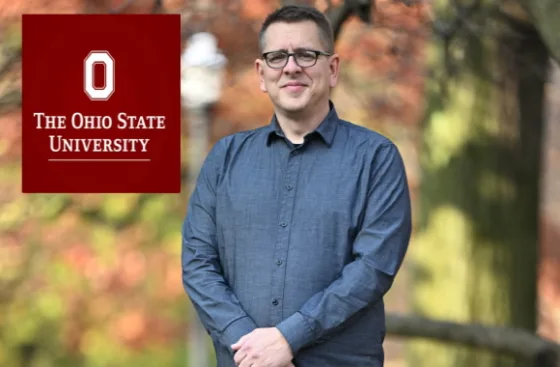
Ohio State University Professor Steven Brown is no stranger to making headlines.
In 2013, he was feted for developing a project to help donations flow to poverty-stricken countries. In 2023, he was touted for earning OSU’s Alumni Award for Distinguished Teaching.
A faculty member for 22 years, most ratings and reviews from students on Coursicle and Rate My Professor sing his praises, describing him as energetic, enthusiastic, and engaged.
Yet, more recently, Professor Brown earned a new achievement.
He was the only professor during the 2025-26 school year to be reported to administrators under the state’s one-year-old law restricting diversity, equity and inclusion in higher education.
Senate Bill 1, passed last year, allows students to file complaints if they feel their intellectual diversity rights have been violated, and universities are required to investigate.
The only other complaint filed during the school year flagged Melissa Newhouse, an executive assistant in the College of Education and Human Ecology, who was surreptitiously recorded by the activism group Accuracy in Media saying DEI is still taught at the school despite SB 1.
Newhouse was cleared, as she is only a staff member and not in charge of curriculum, according to documents obtained by The College Fix.
‘High emotional intensity and moral absolutism’
The complaint against Brown centered on a lecture he gave in late January in the wake of the death of Minnesota protester Alex Pretti at the hands of U.S. Immigration and Customs Enforcement officers.
Tensions across the nation were extremely heightened at the time amid the Trump administration’s increased crackdown on illegal immigration.
According to the student complaint, a copy of which was recently obtained by The Fix through a public records act request, during the lecture Brown conveyed that “the current Republican platform and federal law enforcement are synonymous with the Third Reich.”
“He did not share any other perspectives. He did not explain the legal basis for ICE, the history of border policy, or any mainstream political science arguments that would contradict his comparison,” the student wrote, adding that while Brown “technically invited questions, the offer did not feel genuine.”
“The atmosphere he created was one of high emotional intensity and moral absolutism,” the student wrote. “After a professor labels a political movement ‘Nazis,’ a student who asks a clarifying or dissenting question risks being labeled a Nazi sympathizer by both the professor and their peers.”
‘Not me speaking in that moment’
In a lengthy telephone interview with The College Fix in late August, Brown said it was never his intent to make students feel they could not share their opinion or engage in debate during his “Death and the Meaning of Life” philosophy class.
Brown, whose academic speciality is ethics, said he also does not believe the complaint accurately reflected what happened in the context of the classroom.
Brown, known for exploring the intersections of artificial intelligence and education, said the lecture was an experiment focused on how AI transforms disciplines.
“I wanted to try something where I carefully constructed a series of prompts to draw out these claims that were being made about domestic terrorism and fascism, and how should we try to think about these things carefully,” he said.
He used different AI chatbots to compare and contrast the opinions propagated by the Trump administration that Pretti was a domestic terrorist to teach on inflammatory versus conciliatory language and the paradox of persuasion, he said.
As part of his lecture, he said he stood to the left side of a table at the front of the classroom and, “playing a character,” said to the students: “If Donald Trump is a fascist, if Donald Trump is a Nazi, you have to stop this from coming back to power.”
He said he then purposefully walked to the right side of the table to play the opposite “character,” saying to the class: “No, of course he is not a Nazi. No, he is not a fascist. We still have these checks and balances, and thank God we do.”
“It was not me speaking in that moment, I was playing a character, which I played one way, and then I played a different way, as an educational attempt to vividly display the two kinds of rhetorics,” Brown told The Fix.
‘Education for citizenship’
An investigation into the complaint, conducted in March, ultimately cleared Brown.
“During this meeting, the class diverged from the planned topic, which was supposed to be Aristotle, and instead focused on recent controversies related to immigration enforcement efforts being carried out by the federal government and broader questions surrounding the Trump Administration and concerns about democratic erosion,” according to a March 19 memo detailing the investigation’s findings.
“The discussion of these issues was framed in the context of AI literacy, civil discourse, and the distinction between ‘sophistry’ and ‘rhetoric’ as interpreted through the disciplinary lens of Philosophy,” states the six-page memo, obtained by The Fix.
Evidence reviewed included Brown’s testimony, the student’s written testimony, and reviewing video recordings of the Jan. 29 class and a subsequent Feb. 3 session of the class.
The findings, determined by political science Professor Vladimir Kogan, are that while the student complaint raised “reasonable concerns,” a preponderance of the evidence did not establish a violation of SB 1.
“During the hearing, Prof. Brown explained that this class is likely to be the only Philosophy course most of his students will ever experience, so he sees it as his responsibility to demonstrate to students how the tools and ideas of Philosophy can be used to help understand and interpret current events,” Kogan wrote.
“In addition, he considers his instruction on the difference between ‘sophistry’ and ‘rhetoric’ to be centrally related to the university’s ‘education for citizenship’ mission.”
Kogan did include a caveat, however, that it’s debatable whether the “Death and the Meaning of Life” philosophy class should be included among general education courses that fulfill the university’s “Health and Wellbeing Theme” graduation requirement.
‘I love my students’
Asked by The Fix whether he would do anything differently in retrospect or moving forward, Brown said with a chuckle he’d “play the role of the inflammatory a little less well.”
“I have been teaching here for 22 years, and I learned a long time ago that it is not possible to make everybody happy in the class,” Brown said, adding that he always tries to offer “creative and compelling” lessons.
“When I read the complaint and I heard I had a student who was scared to speak up, then of course it feels like a failure,” he said, adding he wrote the student an apology letter.
“It’s something I care deeply about. I love my students and work hard for my students. If one of my students is scared, then I want to do something differently.”
The goal of higher education should not be to make everybody comfortable, he said, “but at the same time, I hate it that I made my students uncomfortable. It’s messy.”
“I don’t want my students to feel afraid, but I also don’t want my students to feel untouched,” he said. “I was taking a risk, in some ways it didn’t pay off, and I’m listening to that.”
He said it’s tough to navigate teaching under SB 1, because what the law defines as controversial is anything that’s “controversial in the space of politics.”
“So this puts university faculty in a very perplexing position,” he said. “It puts us in a place where we can’t do our job without being fearful of breaking the law.”
MORE: Kent State University fields bias complaints under Ohio’s one-year-old anti-DEI law