
 FEATURED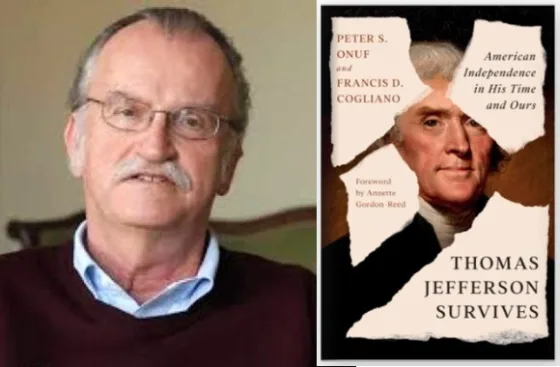
University of Virginia historian’s new book describes Founding Father as ‘complicated,’ ‘wise’ leader often mischaracterized by both sides of political aisle
Just in time for America’s 250th anniversary, University of Virginia historian Peter Onuf wrote a book celebrating the legacy of Thomas Jefferson and addressing the ways modern society mischaracterizes him.
Co-authored with historian Francis Cogliano, “Thomas Jefferson Survives” aims to make clear who the often caricaturized Founding Father really was as an individual and a leader.
The book argues that Jefferson was not who the political left or the political right claim him to be today. It describes Jefferson as a “complicated,” “wise,” and “nuanced” individual. The authors explore his ideals and the ways in which he handled national crises.
“Thomas Jefferson Survives demonstrates how even amid crisis, Jefferson managed to articulate a capacious and optimistic vision for the future of the American people,” a description on the publisher’s website states.
Professor Onuf, a recognized scholar with the Thomas Jefferson Foundation, has written or co-written 14 books. In addition to being a Jefferson expert, he also specializes in the American Revolution and early American history.
Onuf spoke with The College Fix over the phone last week about his new book, the state of history in higher education, and America’s 250th anniversary.
The College Fix: What would you say are the most important things about Jefferson that young adults need to know?
Onuf: I think the most important thing is what he did. He said important things. He was not original on things that he said, but they came at the right moment. That timeliness is what I would emphasize because the American Revolution out of which the American people emerged conscious of themselves and Jefferson’s sensitivity, his ability to listen to the people and to imagine their future, is his great gift to us.
TCF: Are universities doing a sufficient job teaching civics and U.S. histories to students?
Onuf: I think there’s a lot of confusion about what U.S. history is right now, and I’m looking forward to a moment with more attention to the national narrative, to our collective experience, because I think it’s foundational for moving forward. So the short answer is no. There’s a proliferation of new civics institutes, some of which are effective. But the problem goes back to basic education. And we’re at a pivot point in trying to make sense of what we’re doing right now. We’ve had generations of revisionist scholarship, which have showed us a different America. One that we need to take account of, and one that we need to understand in order to move forward. This is a general progressive position, not progressive in the pejorative sense that conservatives might hold it. But it’s predicated on my belief in the capacity of this people, of people of enormous good fortune, to move forward in a constructive way.
TCF: What aspects of Jefferson do you believe are the most often mistaught or left out?
Onuf: One is that he was keyed into a resistance movement. He wasn’t known as the author of the Declaration of Independence in 1776. It was only almost a generation later, during the party battles of the 1790s, that his authorship was emphasized by his father. And his followers, ironically, in partisan opposition to the Federalist administrations of Washington and Adams. So what we don’t understand is how much Jefferson was a man of, and for, a particular moment: a moment of existential crisis for a people that didn’t know it was a people, to British North Americans who had no idea what was going on. So what’s revolutionary about the Revolution is this massive identity crisis and then reconception of who these provincial settlers and their descendants were and how they figured in the world.
TCF: And what prompted you to write the book?
Onuf: Frank Cogliano and I have been good friends, teaching about Jefferson for many years for Gilder Lehrman Institute, and in other contexts as well. He’s younger than I am by a generation. I’m really old, almost 80. And in some ways the collaboration was a continuation of a conversation we’ve been having for a long time.
It would be disingenuous to deny that we are aware that we’re at a moment in our history right now when there’s a real resemblance to the crisis of British North America, the imperial crisis of the 1760s and ’70s. It’s not original insight, but it’s a pretty powerful one. The fundamental focus of the American Revolution is that once they figured out that they were no longer British, the only connection they had had was with King George III. Not surprisingly then, there were powerful anti-monarchical sentiments that emerged in the course of fighting the war. And it’s the attachment of these people to their former king that explains some of the animus, some of the energy in their rejection of him. As you know, the text of the Declaration is largely a list of grievances or complaints directed specifically at George III.
TCF: What do you think he would have to say about America 250 years later?
Onuf: One, he would, despite his legendary optimism, be somewhat surprised and pleased that it survived because he understood that it was on the verge of failure and collapse throughout his lifetime. He thought it was collapsing during the Missouri Controversy, the election controversy or succession controversy of 1800-1801 that led to his presidency. Also, it was a moment of disunion, potential disunion.
And, of course, the Union did fall apart in the American Civil War. That it could fragment, part of it could stay together, and that it could revive and expand the Union thereafter, would be equally surprising to him. He had great anxieties, and I think it’s fair to say that optimism is a close cousin to pessimism. What every revolutionary experienced was radical contingency, uncertainty about the future. And Jefferson was not immune to that. He was unusual in his sense of a possible future, but that possible future, that is, the survival of this experiment in republican self-government, was constantly at risk and could fail.
And every generation, Jefferson wrote in a famous letter to Madison, has to reconstitute itself. It has to do what his generation did. This is not a way of saying that he was a progressive. He did believe in the Enlightenment. He embraced it. If there’s a big difference between then and now, we’re very, very much post-Enlightenment, and it’s hard to sustain faith in the future. That’s what was crucially important to Jefferson.
There’s the spirit of the people. He’d be surprised that we survived, and he’d also think, yes, he could recognize the kinds of problems that we had because we should not underestimate the problems of the revolutionary generation. The Revolution itself was not only a world war, a war against Britain. It was also a civil war in America when Americans declared themselves to be a new people and power of the earth. They do so despite the fact that they’re probably only a minority, and it depends on where you look and when and who you’re talking about. It’s a very dynamic situation in flux.
What Jefferson understood is independence and self-government wouldn’t just happen. They had to be achieved. It depended on the capacity of the people to mobilize, that is, to sustain commitments to a common cause.
If we think we’re polarized now, it’s nothing compared to the polarization or the diversity of that moment. Without a faith in the future, without a vision of what self-government could lead to in America and around the world, you couldn’t possibly sustain a movement, a war against the greatest power on earth. The key thing about Jefferson is how he figures in a situation of radical change and how among all the founders, all the revolutionaries, Jefferson had by far the most faith in ordinary people, which now may seem misplaced depending on what your politics are and how you’re responding in the present moment.
But without that faith that there is a capacity in all of us, if we reason properly, if we estimate what our risks are, what we need to do, and do we have the capacity to do something about it, I think anybody who’s seriously committed to American politics and is a true patriot is going to believe that we do have that capacity.
TCF: How do Jefferson’s philosophies and ideas of what education should be affect education today?
Onuf: Well, in some ways a lot, in some ways not at all. A lot in the sense that he had a very capacious sense of what could and should be studied and what its value was. The elective system is often attributed to Jefferson. It should be remembered that the University of Virginia [which Jefferson founded] was in many ways a failure. I love the place, and I think it does ample tribute to Jefferson’s vision. But the privileged children of the slaveocracy didn’t make the best possible citizens, you might say. But it was a bold project, and it did survive the Civil War and became a great university.
I think Jefferson would be pleased in this respect, because he had his plans, and for his moment, you could call them visionary, but they were not fulfilled. It’s every successive generation of faculty and students – and he would take a very small-D democratic approach to that – has contributed to the emergence of a great national university, a great international university that’s not as it was in the 1930s and 40s. It’s co-ed. It’s got an impressive law and medical schools. And it’s not always that people are thrilled that they’re at Jefferson’s university. Some are. But I think Jefferson would be pleased with the people who make the university what it is today, as different as it is from him and the kids he educated in his own time.
Editor’s note: This interview was lightly edited for length and clarity.
MORE: Civics education expands ahead of America’s 250th anniversary

