FEATURED
For the first time in nearly 20 years, number of green light schools outnumbers number of red light schools
Every year the Foundation for Individual Rights and Expression publishes a large-scale survey on the state of free speech on college campuses across America, and it’s typically filled with dismal results for First Amendment fans.
But this year, there was a silver lining in the survey findings, now in its 19th year.
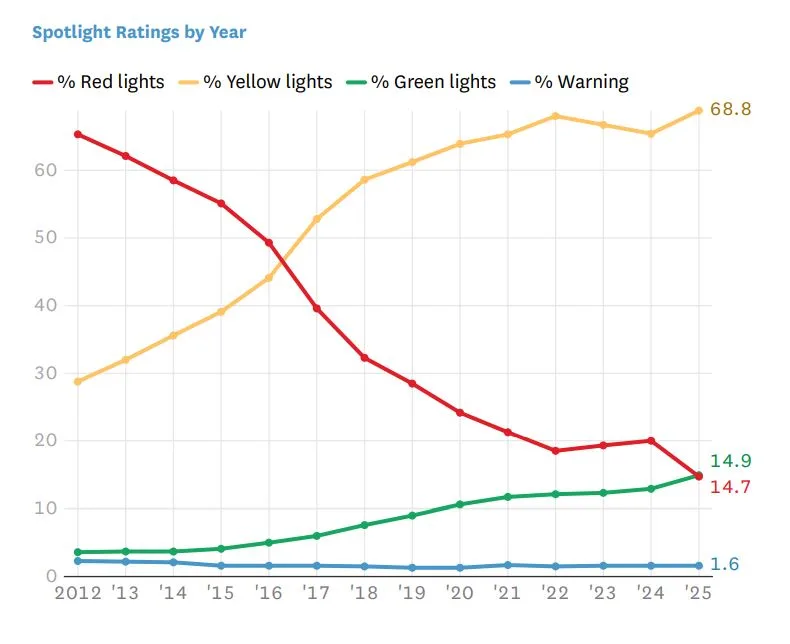
“For the first time in the history of this report, the number of schools that earned an overall green light rating was greater than the number of schools that earned an overall red light rating. This positive milestone marks a stark reversal of a concerning multi-year trend we highlighted last year,” the organization reported in its 2025 report.
The universities did so in part by working with the nonprofit advocacy group to amend the policies driving down their ratings, most notably vague guidelines surrounding harassment, which “can too easily be applied against protected speech,” the group stated.
One university — Louisiana Tech University — even went from earning a right light, FIRE’s worst rating, to a green light, its best.
A spokesperson for Louisiana Tech University, Cami Geisman, told The College Fix that University of Louisiana system leaders started working to address FIRE’s concerns a few years ago.
“Our System president, who now serves as our president at Louisiana Tech, contacted FIRE to explore why 8 of the 9 member institutions received yellow or red lights. FIRE provided guidance on their rating system and what areas contributed to the lower ratings. In January 2024, our general counsel worked with FIRE and internal policy processes to evaluate our legal ability to create a friendlier environment for free expression,” the spokesperson said.
In total, this year FIRE added 10 universities to its green light list, bringing the total number “to an all-time high of 73.”
What’s more, “Dartmouth has the distinction of being the only Ivy League school that earns FIRE’s green light rating.”
While FIRE’s annual free speech survey does help apply pressure, it is “certainly fair to say that the pressure of the federal government likely outweighs any other when it is fully brought to bear on a campus and those examples are also obviously very high profile,” FIRE spokesperson Ryan Ansloan told The College Fix via email.
“But it’s important to note that the voices of students, alumni, trustees, and faculty members have spurred substantial change as well, and are often the reason that additional scrutiny from state and federal officials comes in the first place,” he added.
Ansloan said the organization will work with any university that seeks to improve its rating.
“We often reach out to schools when we learn of newly adopted or drafted policies that may threaten free expression on campus, with the goal of revising these policies before they can be enforced to restrict speech,” he said.
Of the nearly 500 schools included in FIRE’s rating system, 72, or about 15 percent, earned a red light rating for maintaining policies that “clearly and substantially restrict free speech.”
There are 337, or nearly 69 percent, that earned a yellow light rating for maintaining policies that “impose vague regulations on expression,” according to the group.
And 73 schools earned an overall “green light” rating for “maintaining policies that do not seriously imperil free expression,” barely edging out the red light group by one campus.
FIRE reported that multiple Massachusetts campuses also “improved their ratings after the Massachusetts Board of Higher Education revised its Equal Opportunity, Nondiscrimination, and Title IX policy to remove problematic language surrounding its definitions and examples of harassment.”
Reached for comment, the Massachusetts Board of Education did not provide a statement on FIRE’s report to The Fix.
MORE: 1 in 3 students say some level of violence acceptable to stop campus speech: survey