
 BUZZ
BUZZ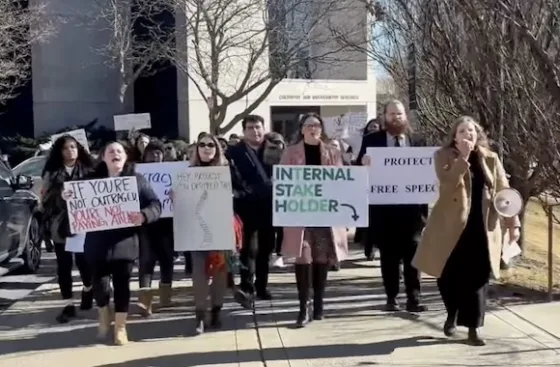
Key Takeaways
- University of Arkansas students protested the revocation of Emily Suski's job offer as law school dean due to her support for transgender athletes, following criticism from Republican lawmakers.
- The protest, which included around 130 attendees, featured placards advocating for free expression in education and was sparked by feelings of shock and anger over Suski's dismissal by the university administration.
- Students and faculty expressed concerns over government influence on academic freedom, with multiple voices highlighting the importance of free speech in academic settings and the potential chilling effect on expert opinions.
- Republican lawmakers criticized the law school for fostering a 'monoculture' in legal education, reflecting broader tensions between state values and academic hiring decisions.
In a “nonpartisan” protest this past Tuesday, University of Arkansas students spoke out against the revocation of a law school dean’s job offer due to her advocacy on behalf of transgender athletes.
The university rescinded Emily Suski’s offer earlier this month “after receiving feedback from key external stakeholders.”
Various Republican lawmakers had criticized Suski’s hiring due to her “friend of the court brief” in support of those challenging a West Virginia law that bans men from competing on women’s sports teams.
The local ACLU, American Association of University Professors, and FIRE all decried U of A’s decision.

According to the Arkansas Democrat Gazette, the roughly 130 students who attended Tuesday’s protest carried placards reading “Hands off our school,” “Keep the capitol out of classrooms,” and “Law school trains minds, not mouthpieces.”
Third-year law student Addison Brooks said Suski “was our choice — the faculty and students both picked her,” but she “was taken away from us by someone who thought they knew better than us.”
The rescission of the job offer “shocked all of us, and we want to show we are capable of advocating,” Brooks added.
Fellow third-year Ethan Brown claimed “everyone was pissed and we didn’t know what to do,” about the news. He said he was “sad, mad and fearful,” but the protest made him feel “proud and grateful.”
Ted Swedenburg, professor emeritus at the university, said he was “proud to see” so many at the protest. He said it’s not the first time UA has attacked free speech, and that when experts are “chilled” from providing their opinions, there is an immense loss of knowledge.
Matt Post has long loved the university, as multiple family members attended UA, but this “government overreach” is unacceptable, said the second-year law student. “There is a place for government in education, but not to tell people what they can or can’t say, which seems” the case in this situation.
As the Suski situation unfolded last week, Post said he recalled teaching English in Ecuador. A student criticized the country’s leader and another student attempted to quash the dissent. Post said that, as an American who holds free speech sacrosanct, he made clear that discussion would always be open in his classroom, even though that freedom isn’t universally shared in other countries.
Now, that freedom of speech “is threatened here, and it seems crazy to think that could happen,” Post said. “I have three nephews and a niece, and if they wanted to go to law school, I don’t think I could encourage them to go to” the UA law school right now.
In response, GOP State Sen. Dan Sullivan said “Law schools nationwide, including ours, have long operated in monoculture echo chambers that reinforce dominant academic perspectives […] many stakeholders, including me, believe that we need to reshape the culture of legal education.”
U of A Law Professor Robert Anderson tweeted on X “State universities, including state law schools, are part of the state government. They exist to serve the people of the state. They can only drift so far from the values and priorities of the state before the people sour on paying taxes to support them.”
I say this a lot, but state universities, including state law schools, are part of the state government. They exist to serve the people of the state. They can only drift so far from the values and priorities of the state before the people sour on paying taxes to support them.
— Robert Anderson (@ProfRobAnderson) January 21, 2026
Reason’s Eugene Volokh, a professor of law emeritus at UCLA, pondered:
Imagine that it came out that someone being considered as a possible dean at a California public law school had signed an amicus brief in opposition to allowing transgender student athletes to compete in women’s sports (or in support of bans on surgical or pharmaceutical gender transitions for youths or something similar).
Would we think that the candidate would be offered the position?
I would very much doubt it. And indeed if the candidate were rejected on these grounds, I think this would be a legitimate position for the decisionmakers (whether the university President, the UC Regents, or the legislators or governor pressuring the Regents) to take. Perhaps if this position were made public, many conservatives would be upset, much as many liberals are with regard to the Arkansas situation. But then too I would say: There’s really not much justification for such upset.
Arkansas Republican Senate President Pro Tempore Bart Hester previously had said “There’s no way the people of Arkansas want somebody […] that doesn’t understand the difference between a man and a woman.”
MORE: U. Arkansas professor who praised Ayatollah Khomeini demands hearing over demotion

