
 FEATURED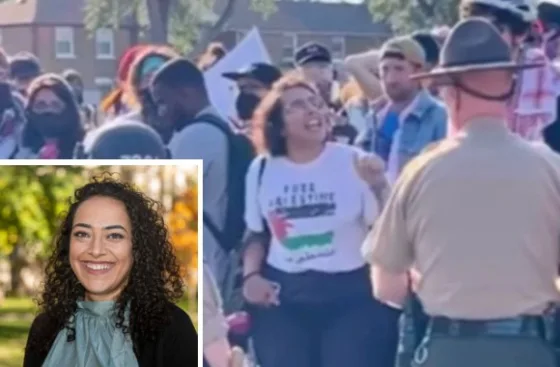
Key Takeaways
- University of Chicago Professor Eman Abdelhadi faces charges of aggravated battery against a police officer during her participation in protests at an ICE detention facility.
- Abdelhadi was arrested in October and then released on bail. She is scheduled back in court later this month.
- She has a history of contentious statements about her university and political figures, including telling the late Vice President Dick Cheney to 'rest in hell.'
UPDATED
University of Chicago Professor Eman Abdelhadi is scheduled to be back in court Nov. 21 after she was charged by the state of Illinois with aggravated battery against a police officer in October.
Her arrest and charges stem from the sociology professor’s involvement in weeks-long protests outside an ICE detention facility in Broadview, Illinois. She is charged with two felony counts of aggravated battery allegedly against a police officer, as well as two misdemeanor counts of obstructing the peace.
On Oct. 4, she was released from Cook County Jail. Three days later, she made an initial court appearance in which she was represented by the Cook County Public Defender’s Office, according to court documents obtained by The College Fix.
After her arrest, the professor appeared to suggest that law enforcement officers were the ones to blame for the violence at the protest. Abdelhadi wrote on BlueSky in October that “ICE rushed at unarmed protesters standing on a patch of grass.”
She also reposted a video of herself yelling “Shame!” at police officers while wearing a “Free Palestine” T-shirt.
Recently, an article in The Contrarian raised questions about why Abdelhadi was being represented by a public defender. According to the report, University of Chicago professors “at Abdelhadi’s rank earn an average of $141,000 annually.”
The Cook County webpage states that a public defender is for “people who cannot afford to hire a private attorney.” The College Fix reached out to the office via email last week for clarification.
Spokesperson Matthew Hendrickson said it “is not an unusual situation for an initial court appearance.” Most people following an arrest do not have the time to hire a private attorney for their initial court hearing, he said.
He clarified: “If a person does not have their own attorney at the hearing, the judge in the courtroom will often appoint a public defender to represent the person at that hearing. We are always staffed in these courtrooms, and it’s why we are there: to make sure everyone has an attorney when they appear in court.”
The representation she would have experienced, according to Hendrickson, would have been “extremely minimal.” With regards to what the hearing was about, it “was just for the judge to let the person know the terms of their release, the most basic of which would be to not commit any new offenses and to show up for all court hearings.”
Hendrickson further clarified Abdelhadi’s representation and stated: “To be clear, the public defender’s office does not represent this person. It is my understanding they have hired a private attorney for their case.”
Neither Abdelhadi nor the university’s media relations office returned two requests for comment from The College Fix over the past week to ask about the charges against her.
However, the fact that a public defender spent time on her case illustrates a nationwide trend of taxpayer funds helping protestors who oppose enforcing immigration law, a Chicago-based fiscal watchdog organization told The College Fix.
Open the Books spokesperson Christopher Neefus said his organization has found “tens of millions of public dollars in California funding nonprofits that fight enforcement” of U.S. immigration law. Regardless of the outcome of the Chicago professor’s charges, these types of cases will still “exhaust even more public funds in court” than necessary, Neefus said.
According to previous reporting from The College Fix, Abdelhadi once described her employer — a prestigious private university — as “evil,” a “colonial landlord,” and a “police force.”
More recently, Abdelhadi also made some less than sympathetic remarks about the late Republican Vice President Dick Cheney, who died Monday, The Fix reported.
“Rest in hell Dick Cheney. Your legacy is death,” she wrote on BlueSky.
Neefus told The Fix that in addition to her case’s burden in the court system, “she’s also being paid to engage in the same ‘anticolonial’ rhetoric that has taken hold across so much of academia.”
Editor’s note: This article was corrected to mention the professor initially was represented by the Cook County Public Defender’s Office.
MORE: U. Chicago professor faces battery charges against police officer at ICE protest

