FEATURED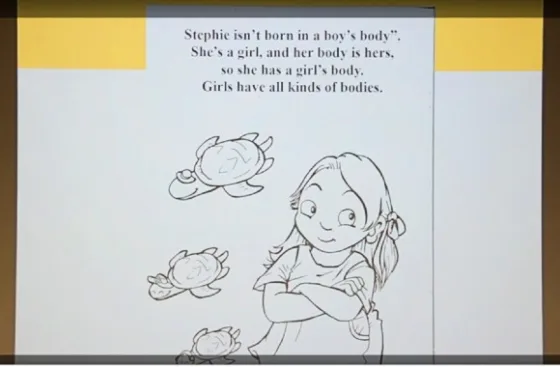
Clinician says she uses ‘gender affirming’ coloring books to teach that ‘all kinds of gender expressions are okay’ and to support ‘pleasure-based positive sexuality’
The University of Minnesota institute behind the controversial MyGender Dolls project also shows young children coloring books that include pages with naked kids who clinicians refer to as “gender creative.”
The College Fix recently reviewed two videos posted in 2025 on the university’s Eli Coleman Institute for Sexual and Gender Health website that describe research and counseling for children who may be gender confused.
No one at the university responded to repeated inquiries from The College Fix about the videos, its research and clinical practices with children, or ethical concerns.
However, a leading pediatric endocrinologist who spoke to The Fix after reviewing the materials described them as “profoundly inappropriate” and essentially “kindergarten pornography.”
The university’s Coleman Institute touts itself as a world leader in gender research.
“The Eli Coleman Institute for Sexual and Gender Health is dedicated to being a global leader in advancing science through research and improving lives through high-quality, compassionate, and evidence-based care for the communities we serve,” the institute told The Fix in a statement via email Monday.
However, it did not respond to a follow up email reiterating questions about its work.
One of the institute’s research leaders is Dianne Berg, a clinical psychologist and professor whose work focuses on children.
Berg is one of the creators of the MyGender Dolls project, which is now the focus of three federal investigations. The paper dolls have interchangeable genitalia, clothing and other accessories. They are being advertised for release this year and are marketed for “trans and gender diverse children” as young as 4.
One of the videos posted last year, which appears be from May 2019, is the presentation “Beginning to Understand Body Dysphoria in Pre-Pubescent Gender Diverse Kids.” In it, Berg talked about her research on “affirmative” treatment for “gender creative children.”
Her recommendations included helping children move “beyond binary expectations of gender” and develop “the foundation for pleasure oriented positive sexuality later in life.”
She said one of the most important aspects of her research is helping “children understand that private parts do not have to define one’s gender identity or gender expression.”
She also stressed the importance of teaching “pleasure-based positive sexuality” from a young age. With young children, she said, that means teaching them to feel “confident and comfortable” in their own bodies through therapy.
Berg faulted many children’s sex education books for sending the message that “what makes someone a real girl or boy is their private parts,” the video shows.
In therapy sessions with children, she said she uses “gender affirming” coloring books to teach that “all kinds of gender expressions are okay.”
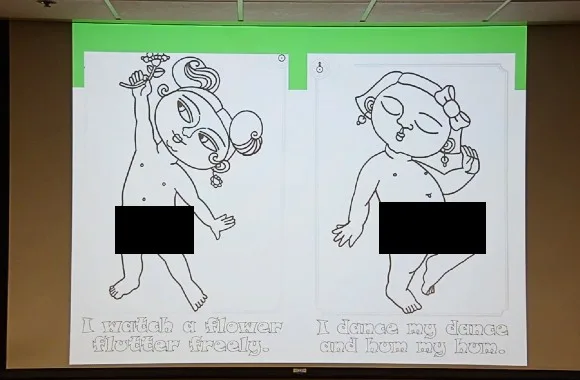
She showed several images from the coloring books, including a page with a young naked boy dancing with earrings and a bow in his hair in what appears to be a sexually provocative pose. The coloring pages appear toward the end of the 22-minute video.
Another coloring page shows a child with what appears to be a young female body and genitalia — but with muscles and short hair and masculine features on the upper half of the body.
This image prompted Berg to share an anecdote about working with a “female-assigned 7-year-old who has socially transitioned and when we got to this particular page, he said with great excitement, ‘That’s me!'”
“Seeing one’s identity accurately represented is not only a powerful antidote to shame, but a building block of pleasure-oriented positive sexuality,” Berg said in the presentation.
“What we’re trying to do both with our assessments and our therapy, as well as our research, is really try to figure out what are these kids telling us, what do they actually need, and how can we provide the support to be affirming as well as informing decisions that are getting made as they grow up,” she said.
Berg’s bio and profile appear to have been removed from the institute website sometime in May. An email to Berg last week came back with an automated response stating she is on sabbatical from May 15 through Oct. 19.
She and other institute researchers also are involved in the “GenderFlex” study, which interviewed children ages 5 to 8 about gender issues.
In another video presentation on the university website, this one dated May 2, 2023, the researchers described their work thus far. The presentation included Berg and Nic Rider, co-director of the university’s National Center for Gender Health.
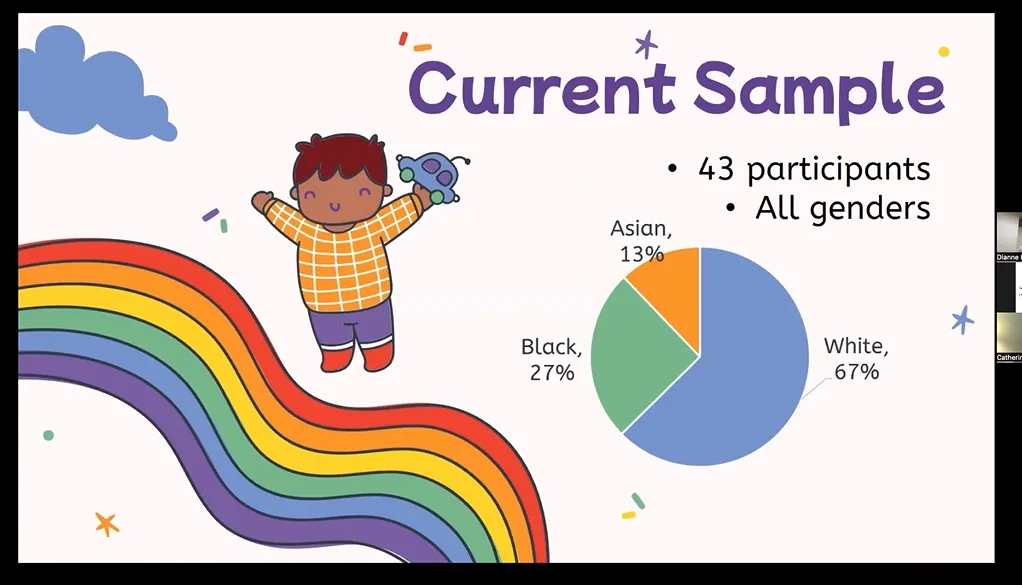
As of the date of the presentation, researchers said they had interviewed 43 children. No one at the university or institute answered The Fix’s inquiries about whether the study is on-going.
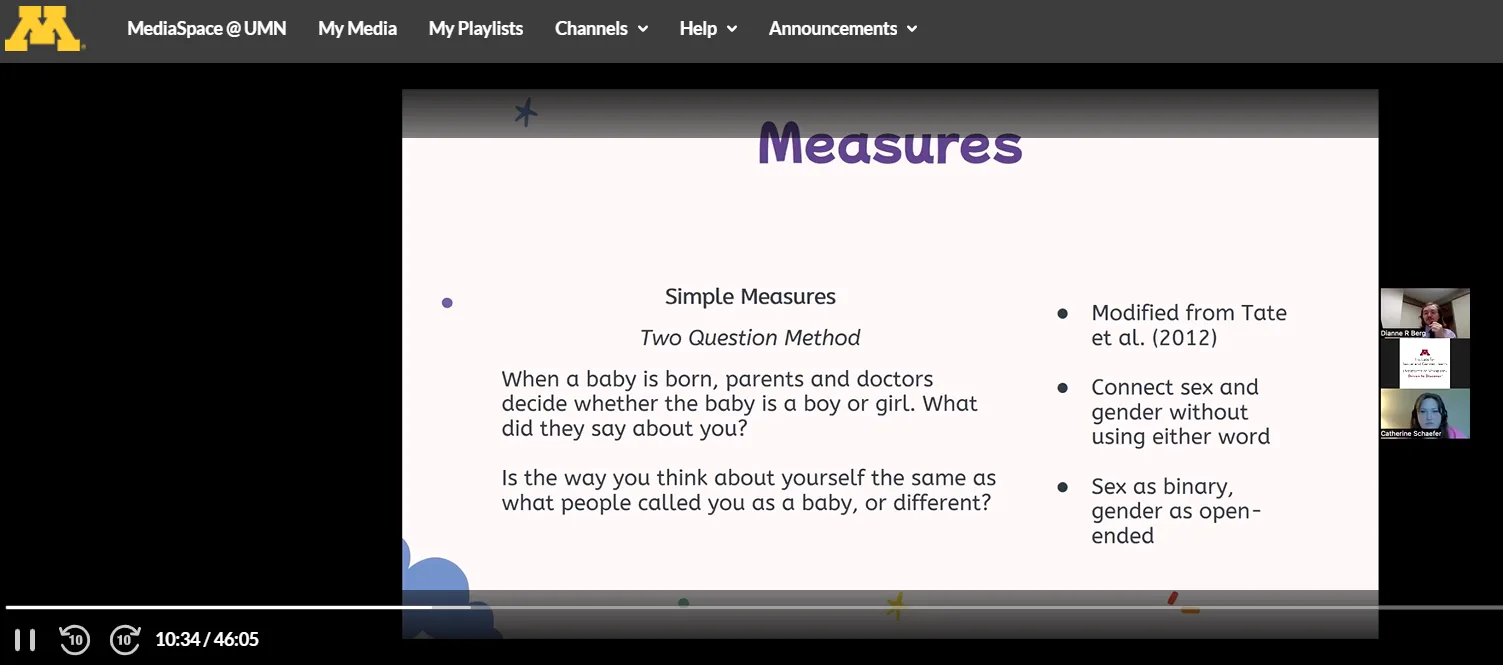
One question researchers asked the children is: “When a baby is born, parents and doctors decide whether the baby is a boy or girl. What did they say about you?”
Another was: “Suppose you were not born yet and you could choose what gender you would like to be, what would you choose? boy? girl? or another gender?”
The goal of the study is to learn how children understand gender terminology and figure out the best ways to talk to them about their gender, according to the presentation.
“At the core of it is, can we have conversations with kids about gender and be able to help them have a nuanced conversation?” one of the researchers said in the presentation. Because the researcher spoke off screen, it is not clear which one was speaking.
“Because at the end of the day one of the biggest arguments is that [inaudible] kids, preschool kids can’t talk about gender and that quote unquote cis kids will be confused if you ask them about gender, and we know that this isn’t true,” the researcher said.
Along with the institute, The Fix also contacted Rider and the university media relations office to ask about the presentations, including how the GenderFlex study was funded and how they would respond to ethical concerns about their materials and statements involving young children.
None responded to several attempts to contact them over the past week via email. The media relations office had a busy signal when The Fix called on Tuesday, attempting to follow up again.
Reached for comment, a pediatric endocrinologist and former president of the American College of Pediatricians who spoke with The Fix said children in the study are too young to understand the gender ideology being pushed on them at the public university.
Dr. Quentin Van Meter said the university’s clinicians claim to be forward-thinking by helping children “grow up to be their true sexual selves.” In reality however, they are planting “deceitful ideas” in impressionable young children’s minds, he said.
Gender dysphoria always has been a mental health issue, he said. There is no science to back the claim that parents and doctors assign a child’s sex at birth or that sex is a spectrum; it’s all ideology — “a house of cards built on sand,” Van Meter said.
“Sex is determined at fertilization. Period,” he told The Fix in a phone interview.
When asked about the coloring pages, he described them as “kindergarten pornography essentially.” He said UMinn’s work reminds him of the late Alfred Kinsey’s experiments with masturbation in very young children — essentially “sexual abuse.”
As The Fix previously reported, the Eli Coleman Institute for Sexual and Gender Health received $1.35 million in research grant funding in 2024, according to its annual report.
However, the report does not specify the sources of the funding. The University of Minnesota is a public, taxpayer-funded institution.
Currently, the university is facing three federal investigations over its MyGender Dolls project from the U.S. Department of Education, the U.S. Senate Health, Education, Labor, and Pensions Committee, and U.S. Rep. Tim Walberg, chair of the House Education and the Workforce Committee, The Fix previously reported.
MORE: UMinn scholars launching transgender doll project for 4-year-olds
MORE: UMinn facing third investigation into therapy dolls with ‘interchangeable genitalia’