BUZZ
BUZZ
‘There is no categorical ‘harassment exception’ to the First Amendment’s free-speech clause’
University of California students who do not wish to call someone by their preferred pronouns may do so without fear of punishment thanks to a court ruling this week.
U.S. District Court Judge Fred Slaughter granted a preliminary injunction against a UC system policy that could punish students for “dead-naming” peers.
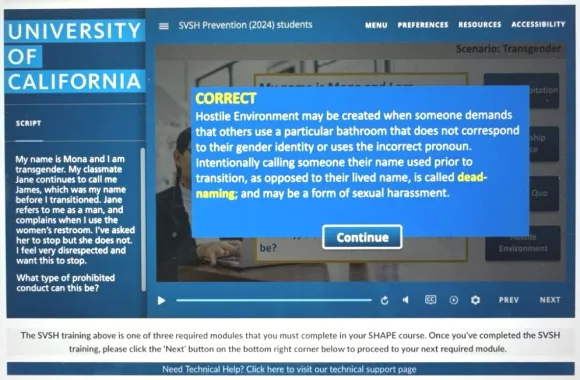
Citing precedent that “there is no categorical ‘harassment exception’ to the First Amendment’s free-speech clause,” Slaughter — a Biden appointee — ruled that the students “have demonstrated a credible threat of enforcement.”
The lawsuit, filed in June by Defending Education, targeted UC’s Sexual Harassment, Anti-Discrimination, Prevention and Education training that informs students that intentionally “calling someone their name used before transition, as opposed to their lived name, is called dead-naming, and may be a form of sexual harassment.”
The lawsuit also flagged an anti-discrimination policy that prohibits harassment that creates a “hostile environment,” citing protected categories of “gender, gender identity, gender expression, gender transition.” Under this policy, harassment may occur when someone’s preferred pronoun is not used.
Defending Education “argues that UC compels students to use preferred pronouns which, beyond compelling speech, amounts to a viewpoint-based regulation,” Judge Slaughter wrote. “The court finds that DE’s position is supported by case law.”
Slaughter stopped short of approving Defending Education’s request that the entire “hostile environment” provision be scrapped, stating campus leaders may still “prevent the abuse of transgender students, just as they enforce the policy to prevent the abuse of all other students.”
In a news release, Defending Education stated the injunction “bars UC from enforcing that policy against our members at UC schools for referring to others using biologically accurate pronouns and names, in accordance with their sincere beliefs.”
“The injunction stays in place while the case moves toward a final ruling on whether the policy is constitutional, and we look forward to securing lasting protection for students’ free speech across the UC system.”