FEATURED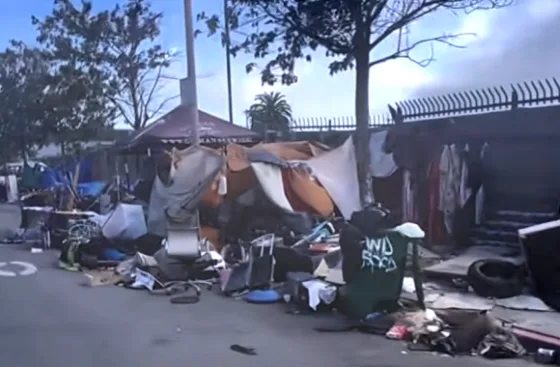
Homeless camp has been source of fires, dead rats, and infectious disease Leptospirosis
A viral video taken by a parent recently dropping her son off at UC Berkeley prompted alarm by revealing large camping tents, trash, sleeping bags, garbage, tarps, dirty mattresses, bikes and other debris piled up in heaps and spilling out into the street for several blocks.
“I just dropped my son off at @UCBerkeley housing and as we were approaching we saw this behind his apartments,” parent Lyanne Melendez posted on social media Aug. 19.
The video, which has racked up more than 3.5 million views, depicts a long-standing homeless encampment at Eighth and Harrison streets in the city of Berkeley. While city officials and residents have battled for years to clean it up, the video prompted a new wave of headlines.
It sits directly outside of the UC Berkeley University Village, which houses roughly 3,500 residents, including more than 700 residents under the age of 18, according to a UC Berkeley housing website.
Berkeley city officials have tried to shut down the encampment but have been blocked by homeless rights advocates in court.
Meanwhile, Judge Edward Chen has repeatedly delayed the city’s requests to break down the camp, most recently earlier this month ordering city officials to walk Berkeley’s streets with the Berkeley Homeless Union and find residents somewhere else to go.
At issue is the ADA, which requires individually assessing each disabled resident before closure. In court filings, the city alleges BHU won’t share the information necessary to finish. The homeless union counters that the city is at fault for delays.
The encampment is “a serious fire hazard that has resulted in multiple nearly catastrophic fires,” attorneys for the city argued in recent court documents, noting Berkeley’s fire department has responded to 55 calls for service in the corridor this year alone, and the encampment was formally declared a fire hazard on July 27.
Those concerns were underscored Aug. 18, when Patrick Ford, 60, allegedly set a debris fire at the encampment after someone stole his scooter, then was seen walking away with a torch in one hand and a gas can in the other, according to the Berkeley Scanner.
The fire concerns come alongside several accounts of non-fire hazards, with city community services noting “dead rats all over the streets,” as well as regular instances of “visible bodily fluids and feces” on the ground, court documents state.
Leptospirosis was first detected in the encampment’s animals in December 2025, when Alameda County Vector Control trapped 40 rats and every one tested positive, the Daily Californian student newspaper reported in January.
Two individuals living near the encampment became the first human cases of the outbreak, testing positive for leptospirosis in May 2026, one dying shortly after.
The city says it’s aware of no additional cases since, Berkeley’s Director of Health, Housing, and Community Services Scott Gilman told The College Fix.
The court had already recognized the broader public health risk in April, finding that “the presence of leptospirosis in the encampment is a significant threat to the health and safety of … residential properties like the University Village which serves UC Berkeley students with families.”
The lawsuit driving this fight represents the latest chapter of a legal effort beginning in 2023, with a short-lived health and safety abatement completed that November, following an initial temporary restraining order.
Several more closure attempts followed, culminating in a suspended closure attempt that December. The area was “re-encamped within hours,” per the city.
When The College Fix reached out to UC Berkeley last week, asking whether the university had taken any steps to protect student safety near the site or played any role in the city’s effort to clear it, spokesperson Dan Mogulof said: “That encampment is not on University property. It is on City of Berkeley property and under their jurisdiction. Please contact the municipal government.”
Laura Riley, an assistant dean at UC Berkeley Law and author of “Homeless Advocacy,” told The College Fix that the risk at the Harrison Street Encampment is not to students but to “the unhoused people who are living in tents that are subject to abatement at any moment.”
They rely on the city of Berkeley, rather than UC Berkeley, to not “improperly seize and dispose of their property,” she said via email.
She also told ABC News that the “reality is there’s not enough places for people who are currently unhoused and unsheltered to go.”
Jeff Morgan, owner of nearby Covenant Winery and a plaintiff in the 2024 nuisance suit against the city over the encampment, has a very different understanding of the risks.
“The disease, fire, rats and violent behavior stemming from the encampment doesn’t stop at the entrance to student housing,” Morgan told The College Fix. “So yes, everyone who is near this encampment is at risk.”
MORE: UC Berkeley is giving back old corn cobs to Native American tribe