FEATURED
Archaeologist says an anti-scientific ‘decolonization’ agenda is dominating the field
A training program hosted by Indiana University advised public employees that “tribes are in control” and “tribal knowledge is sufficient” when they are working to return Native American artifacts in their research labs and museum collections, according to records obtained by The College Fix.
The INSTEP program, which took place July 7 to 11, offers training for university and other public institutions’ employees and students on compliance with the Native American Graves Protection and Repatriation Act, or NAGPRA. The federal law requires public institutions to make an effort to return human remains and certain cultural artifacts to Native American tribes.
However, two scholars who spoke with The College Fix expressed concerns about sections of the presentations that appear to prioritize Native American tribes’ wishes and beliefs over academic research and knowledge.
One slide in a “NAGPRA 101 – Legal Processes” presentation addresses how to identify the tribe to which an artifact belongs. It should be “fairly easy to determine” the cultural identity of an artifact, according to the slide, obtained through an open records request.
“Very little should be unaffiliated” and an examiner “[does] not need all lines of evidence; one is enough,” the presentation states.
“Affiliation [is] not based on scientific certainty,” one slide says.
Elizabeth Weiss, emeritus professor of anthropology at San Jose State University, told The Fix in a recent email that most artifacts in the hands of universities today were “never meant to be repatriated” because they are “the truly unaffiliated materials.”
“NAGPRA was intended to repatriate human remains and some specific types of artifacts… to culturally affiliated modern tribes. This affiliation was meant to be determined by a preponderance of evidence — including, but not limited to, biological, historical, geographical, and archaeological data,” she said.
Human remains and other items that belonged to tribes were returned years ago, and “what’s left now, in museums and universities, is the truly unaffiliated materials,” she said.
Weiss said that “it’s exceedingly difficult — and often impossible — to affiliate prehistoric materials with modern tribes.” She said some tribes no longer exist, and others have merged – “and, there are even some modern tribes that are not Native American at all.”
Weiss said she thinks “the push to repatriate culturally unidentifiable materials comes in large part because Native American repatriation activists don’t want the gravy train of money they receive from government grants… from drying out.”
“For anthropology and archaeology repatriation activists, they have likely been indoctrinated to believe that anything a tribal elder says is not to be questioned,” she said.
Spencer Pelton, Wyoming state archaeologist and adjunct professor at University of Wyoming, echoed how difficult determining cultural affiliation can be for objects that are more than a few hundred years old.
He told The Fix in a recent email: “The move to do away with unaffiliated objects and human remains was a response to the Kennewick Man case, where archaeologists successfully argued that ancient human remains (in that case ca. 8,500 years old) could NOT be affiliated with modern people in any cultural sense.”
“Kennewick Man might be distantly related to modern people biologically, but biological and cultural relatedness are very different things.”
Pelton added, “As a response to that case, the Department of the Interior devised the concept of ‘geographic affiliation’ in their 2010 regulation changes, which states that any set of human remains can be affiliated based solely on where they were found, regardless of age.”
However, these “regulatory changes seemingly contradict congressional intent and legal precedent,” he said.
“Many modern Tribes contend that they were created in the places where they live today, so there is no need to use the tools of science to establish cultural affiliation,” — and these beliefs were “enshrined in the most recent NAGPRA regulation changes as ‘Native American Traditional Knowledge,’” he said.
Pelton added that, until the 2023 update to the federal law, “only human remains and other specific types of objects were subject to repatriation, but that has now changed to potentially include ALL archaeological objects regardless of their association with human remains.”
Other slides from the Indiana University NAGPRA training back up Pelton and Weiss’ comments. For example, a “Consultation 101” slideshow about working with tribal leaders states that “Tribes are in control of this process!”
It additionally advises public university employees that “‘We owe it to science’ is an unacceptable statement,” and that “Specimens is an offensive term.”
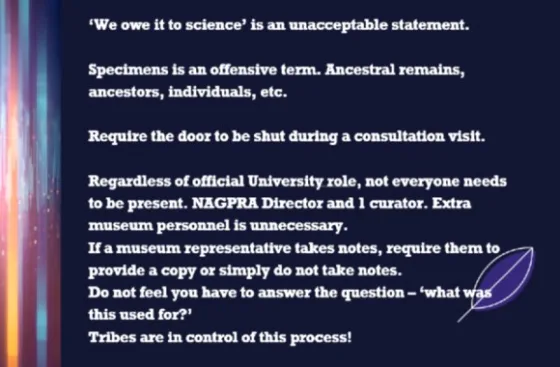
Weiss said she had “encountered such rhetoric before” and provided examples of other words that were considered insensitive, such as “cranium” and “burial.”
“The reason to censor such language, and to argue against science, is to remove objectivity from the field and to fill it with feelings of guilt and oversensitivity,” she said.
Weiss continued, “Anthropologists and archaeologists will then sympathize with the repatriation activists, instead of allowing their curiosity to discover the real prehistory of the Americas.”
“Telling the most accurate story of the past through science is our job as anthropologists and archaeologists; we do owe it to science; and, it’s the best way to honor the lives of those who came before us,” she said.
Pelton agreed that this sort of rhetoric has become “common.” He explained that the favoring of Indigenous knowledge is the driving force behind the changes in language.
“The repatriation movement has for several years been subsumed under the larger ‘decolonization’ political project, which is overtly opposed to scientific ways of understanding the world in favor of Indigenous knowledge systems,” he said.
“‘Specimens’ is a term of science, so it needs to be offensive in order to be removed. ‘Human remains’ was ditched in favor of ‘ancestors’ for the same reason. It’s all just a part of cleansing the discourse of rhetoric even remotely related to science,” he told The Fix.
Two other presentations from the INSTEP training discuss legal requirements and federal NAGPRA regulations, which were updated in January.
One presentation states that regulations were updated due to “Unsanctioned research/exhibit of cultural materials by museums and institutional researchers without tribal consent,” “Slow nationwide repatriation efforts,” “Lack of transparency by academic faculty,” “Institutional rush/lack of investment without tribal partnership development,” and “Lack of deference to tribal knowledge/opinion.”
In describing how universities and museums can determine the “cultural affiliation” of an artifact, the presentation states that “Tribal knowledge is sufficient,” including “Archaeological,” “Folkloric,” “Historical,” or “Oral Traditional.”
In another presentation about “repatriation and reburial,” staffers were advised to “not write information down regardless of institutional policy,” if they participate in a tribal reburial.
The presentations obtained by The Fix did not include the names of the presenters. The Fix reached out to both IU’s NAGPRA office and its media relations office multiple times asking for more information about the training and context for the presentations, but did not receive a response.
The INSTEP training, first held in 2023, was discussed at length by Indiana University’s NAGPRA director Jayne-Leigh Thomas on an August 2024 podcast, The Fix previously reported.
On the podcast, Thomas admitted to not telling airlines that she was bringing human remains on planes for transport to Native American tribes, which appears to go against some airline companies’ policies.
MORE: Indiana U. ‘repatriation’ director: I don’t tell airline when carrying human remains