BUZZ
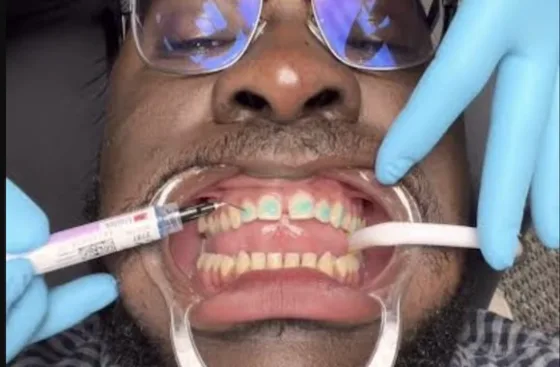
‘Eurocentric epistemology … continues to reproduce colonial legacies concerning knowledge [and] power’
Academics from South Africa’s University of the Western Cape recently put out a report “challenging coloniality in dental education” … along with its “hidden curriculum.”
According to an article in Bioengineer.org, Tasneem Ajam, Sizakele Precious Ndwandwe, Seyi Ladele Amosun, and Danelle Hess claim “Eurocentric epistemology” has “historically formed” dental education and “continues to reproduce colonial legacies concerning knowledge, power, and being through an unwritten, informal […] curriculum.”
The authors cite Paulo Freire‘s “Pedagogy of the Oppressed” which argues “liberation [is] required in education to free the mind,” and claim dentistry training “exists within this transforming environment.”
Although dentistry is an “evidence-based” discipline, Ajam et. al. say the issue is not the “content of dental education itself but in whose knowledge is prioritized and how students are taught.”
“Epistemic injustice,” cited as an “unfairness related to how individuals are recognized in their capacity as knowers,” is a term used throughout the report, with the researchers claiming examination of such “brings attention to subtle unspoken clinical traditions that may overlook culturally diverse or non-biomedical perspectives.”
“Legitimation code theory,” used to “analyze and improve teaching and learning, assessment, and curriculum design to ensure that no student is left behind,” is used by Ajam and her team to “balance scientific rigor with social awareness.”
Part of this theory is “semantic waves,” which increase knowledge via a balance between “semantic gravity” (the concrete) and “semantic density” (the abstract).
In terms of dentistry, semantic waves would have teachers ask students to use terminology “from their indigenous home languages” to help make sure “traditions or accents do not supersede understanding.”
With regards to assessment, things that teachers need to be aware of are students’ anxiety-causing “resource constraints” such as smartphone and internet access, and “group” transportation.
The researchers’ “positionality stems from lived experiences, both as students and their ongoing professional growth,” the report concludes. “Acknowledging the unwritten informal culture and norms within dental education will enhance the development of the professional identity of the student.”
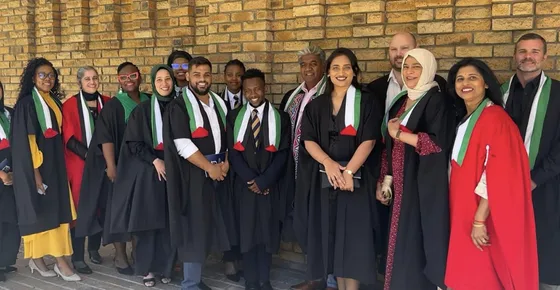
In 2023, the University of the Western Cape’s dentistry staff celebrated graduation “with a nod to Palestine”:
MORE: South African academics offer a glimpse of what ‘decolonization’ means for science
MORE: ‘Flourishing forests’ of indigenous scientists can ‘transform’ and ‘decolonize’ science