BUZZ
BUZZ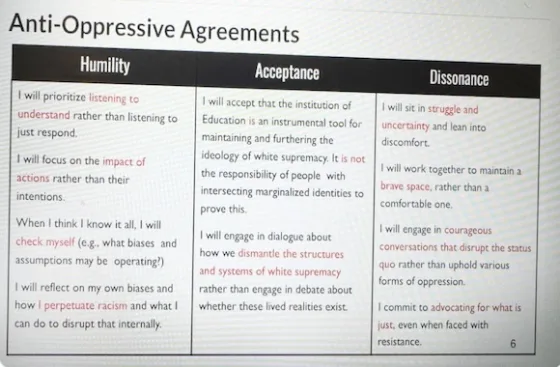
‘Accept that their place of employment is a ‘white supremacist’ institution
Teachers at an Ontario, Canada elementary school recently were shown several “anti-oppression agreements,” among them “accepting” that their place of employment is a “white supremacist” institution.
According to Jonathan Kay on X, the agreements from the unnamed York Region District school also included teachers “reflecting” on how they “perpetuate racism,” and discussing how to “dismantle structures and systems of white supremacy” instead of “debating whether these lived realities exist.”
Others read “I will focus on the impact of actions rather than their intentions,” “When I think I know it all, I will check myself” (consider “what biases may be operating”), “I will work together to maintain a brave space rather than a comfortable one,” and “I commit to advocating for what is just, even when faced with resistance.”
The National Post reports the agreements were featured at a September 14 staff meeting. The district did not respond to its request for comment.
Kay noted teachers reportedly weren’t required to recite them or otherwise “indicate commitment.”
Oddly enough, the slide of the agreements appears virtually identical to one used by the York district three years ago for an English as a Second Language training.
Then, the original wording at the beginning of each statement was “I choose to,” but the last two words were crossed off and replaced with a highlighted “will”:
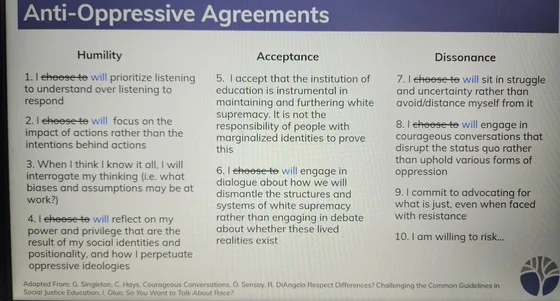
The bottom of the slide indicates the agreements are “adapted” from material by “White Fragility” author Robin DiAngelo and the “Courageous Conversations” program by Glenn Singleton.
DiAngelo, whose definition for the term she coined is “a state [for white people] in which even a minimum amount of racial stress becomes intolerable,” believes the United States has too many white teachers and that whites who treat everyone equally are “dangerous.”
Singleton believes there are actual racial differences in the ways whites and black communicate; the former utilizes “verbal,” “intellectual” and “task-oriented” language, while the latter’s is “emotional” and “personal.”
In 2024, the Post notes York published a “framework” titled “Dismantling Hate and Oppression” which asserts schools still face a “persistence of colonial ideology and culture,” and that “the ideology of white supremacy impacts attitudes and behaviours in all peoples, regardless of race, culture, gender, or religion.”
One of its recommendations is “embed[ding] actions to dismantle hate, oppression, and discrimination” into the current “School Improvement Plan.”
Also that year, the Elementary Teachers Federation of Ontario’s “anti-oppressive framework primer” claimed that school spirit events like “Crazy Hair Day” are “inherently oppressive” as they “perpetuate a ‘dominant Euro-centric culture’ while also stigmatizing the mentally ill.”
MORE: Lecturer cautions students not to challenge her on ‘systemic oppression’