FEATURED
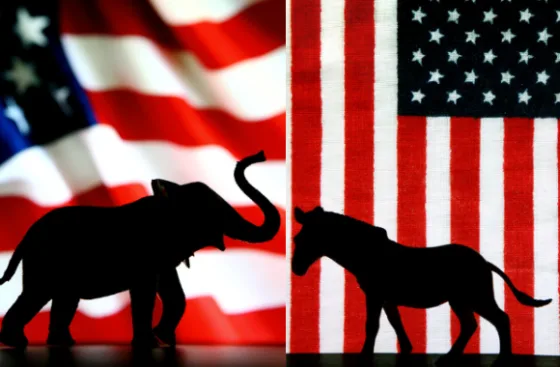
ANALYSIS: Georgia political science faculty skews heavily Democratic among primary voters
Democrat political science professors outnumber their Republican peers by a nearly 6-to-1 margin among identified primary voters at Georgia’s four largest public universities, according to a new College Fix analysis.
The disparity is the greatest at the Georgia Institute of Technology, where 11 Democratic professors were identified, but zero Republican ones. The school does not have a political science department, but The Fix looked at its public policy program, the closest equivalent.
At Georgia Tech, 5 nonpartisan professors were identified, and 14 were undetermined.
For the overall analysis, The Fix reviewed the voting patterns for 97 political science professors at University of Georgia, Georgia State University, Georgia Institute of Technology, and Kennesaw State University. Only full-time professors, not adjuncts or instructors, were reviewed.
The determination of political affiliation is based on the most recent primary ballot pulled.
Of the 97 investigated, 49 professors’ affiliations were determined as either Republican, Democratic, or nonpartisan.
In total, The Fix identified 29 Democrat professors, 5 Republicans, and 15 nonpartisans. When broken down by party, 85 percent of identified professors are Democrat, while only 15 percent are Republican.
Research on the University of Georgia found six Democrat professors, three Republican ones, five nonpartisan professors, and nine who could not be determined.
In Georgia State University’s political science department, six Democrat professors were found compared to one Republican, with 14 professors whose affiliations could not be determined, and two nonpartisan voters.
Kennesaw State University’s government and international affairs department has similar numbers, with six Democrats, one Republican, 11 indeterminates, and three nonpartisans.
The total ratio comes in at nearly a 6 to 1 margin of Democrats to Republicans for identified professors.
Hiring is nonpartisan, official says
At Georgia State University, the analysis found six Democrat professors and one Republican.
Amy Steigerwalt, department chair of political science, said she did not know the accuracy of the results, because her department does not consider politics when hiring.
“Instead, we assess the rigor of one’s research and encourage methodological and theoretical diversity,” she said. “And we strongly believe in academic freedom.”
She continued:
Most important, our faculty engage in systematic and empirically-driven social scientific research. That means that we only report findings that are the result of replicable data analyses, and are not simply reflections of personal views; and, that means we also report them even if they may contradict what we may have personally believed going into the research project.
We have faculty that conduct research on political polarization, comparative democratization, interbranch relations, voting behavior, and international security, to name but a few primary research interests.
The only Republican professor found at Georgia State declined to comment.
Department chairs at Kennesaw State, Georgia Tech, and the University of Georgia also did not respond to emails and phone calls sent in the past two weeks, nor did the four other identified Republicans.
The Fix asked about reasons for the political imbalance and the importance of viewpoint diversity to the department.
Methodology
The Fix determined a professor’s affiliation based on how he or she voted in the most recent primary election in the county where the school is located, although in some cases The Fix had additional voting history available.
The records came through a paid public records request through the Georgia Secretary of State’s office. The 48 professors who could not be found in the rolls may not show up because they are registered in a different county, not registered to vote at all, or have not voted in a primary.
Georgia has an open primary system, where anyone can vote in the primary of their choosing. Peach State voters do not register with a party when registering to vote, so the Fix used the most recent primaries instead.
Nonpartisan means the voter took a ballot that only included questions about referenda or judges, but did not include candidates with an explicit political party.
Voter registrations were matched using a program called Anomaly AI that provided both confirmed matches and ambiguous situations, such as multiple registrations with the same name.
In these cases, The Fix manually tried to match identifying information from curriculum vitae and other public sources to determine the best matches. A researcher for The College Fix also manually ran a first review on a majority of the registrations.
Across party lines
Because many of the registrations rely only on the 2026 primary, it is possible professors identify with a different party but chose the opposite party for strategic reasons.
For example, two of University of Georgia’s three professors who most recently voted in the Republican primaries have published work on typically left-leaning topics, such as feminism, racial politics, gender, and diversity, equity, and inclusion.
Likewise, another UGA professor voted Republican in 2022 and 2024, but voted Democratic in 2026. The Fix labeled her as a Democrat.
The Republican professors did not respond to inquiries about which party they most aligned with.
This is not the first time the Fix has found unbalanced politics in higher education.
In 2022, The College Fix found 98 Democrats to 1 Republican in Cornell humanities departments.
More recently, and also in the Peach State, a 2024 investigation of UGA’s entire faculty found a 7 to 1 Democratic to Republican ratio, and found three departments without any Republicans employed at all.
Democratic political scientists also outnumber their Republican peers by a 28 to 1 ratio at major universities across Pennsylvania, a recent College Fix analysis found.