FIX EXCLUSIVES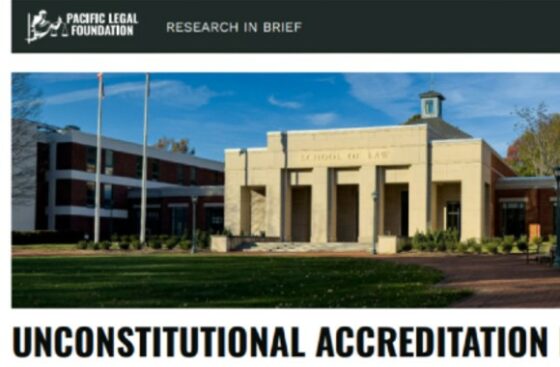
Bar association official denies claims, saying its accreditation process follows the law
The American Bar Association places pressure on top public law schools to implement “unconstitutional” race and sex-based preferences in admissions and hiring, according to a new report by the Pacific Legal Foundation.
The foundation’s report, published in July, says the ABA does this through its “monopoly” accreditation process.
However, a bar association official denied any unlawful discrimination when contacted by The College Fix.
Pacific Legal, a public interest law firm focused on defending individual liberties, based its findings on accreditation reports from 45 of the top 50 public law schools through open records requests from 2014 to 2023.
The report found that 20 of the responding schools were criticized for failing to meet the ABA’s “diversity standards,” thus risking their accreditation status. These criticisms include failing to hire a sufficient amount of faculty from minority groups, having “limited DEI curriculum integration,” and “not having enough LGBTQ+ support groups.”
According to the report, these standards often require or encourage practices that conflict with the U.S. Constitution and state and federal civil rights laws.
“The ABA has told law schools that they have to implement the ABA’s own problematic diversity standards, even if state or federal law might prohibit them from doing so,” Zack Smith, senior legal fellow at the Heritage Foundation, told The Fix recently when asked about the report. Smith previously worked as an assistant U.S. attorney in Florida.
The findings center on the bar association’s accreditation Standards 205 and 206, which obligate law schools to demonstrate a commitment to diversity and inclusion regarding students, faculty, and staff in terms of race and sex by the virtue of “non-discrimination,” according to the foundation’s report.
Schools that fail to meet these standards risk punishment and a loss of accreditation, according to the report.
The report documents examples of schools being pushed to adopt racial preferences despite state-level prohibitions. In one case, Charleston School of Law was denied accreditation until it agreed to appoint a diversity director to remediate concerns regarding sufficient racial diversity in the school.
In another example, George Mason University School of Law faced an extensive ABA investigation that ended only after the school “quietly lowered” its admissions standards for certain racial groups to satisfy the accreditor’s diversity requirements.
The American Bar Association is the only accreditor of juris doctorate programs, so it wields significant influence over law schools — “monopoly power,” according to the report. This gives the ABA a “quasi-governmental” status that makes its positions and pressuring of universities unconstitutional, the report states.
“The quasi-governmental nature of the ABA demonstrates the importance of a permanent legislative solution to address this problem, since it isn’t clear whether it can be readily addressed under existing law,” Caitlin Styrsky, a co-author of the report, told The College Fix in a recent email.
MORE: Harvard disputes claims its law review discriminates based on race, gender
However, the ABA denied the report’s assertions emphatically when contacted by The Fix.
“Contrary to the statements in the publication, the accreditation standards are assessed within the context of applicable laws, and the council has not required any institution to choose between compliance with accreditation standards and legal obligations,” Jennifer Perea, ABA director of legal education and admissions to the bar, said in a recent email.
Following the 2023 U.S. Supreme Court ruling Students for Fair Admissions v. Harvard that deemed race-based admissions unconstitutional, and amid growing pressure from the Trump administration, the ABA announced in February a temporary suspension of Standard 206 until Aug. 31.
In the meantime, it is reviewing “potential changes to ensure compliance with the recent executive orders and the U.S. Department of Education’s ‘Dear Colleague’ letter,” according to an ABA news release at the time.
President Donald Trump issued an executive order earlier this year directing federal agencies to end racial preferences as a condition for accreditation, but the Pacific Legal report contends that deeper legislative action is required.
The executive order is vulnerable to reversal under future administrations and the ABA’s only “quasi-governmental” status makes it easy for it to evade federal law, the report states.
As a solution, the report proposes amending the Higher Education Act to explicitly prohibit accreditors from mandating or investigating race or sex-based diversity standards in their accredited schools.
Smith with the Heritage Foundation posed another solution to The Fix. He said the Department of Education could “recognize another federal law school accreditor” in order to provide alternative ways for graduates to sit for state bar exams, and to weaken the ABA’s monopoly on accreditation.
MORE: Gov’t withholds $108M as Duke law review, Duke Health probed for racial bias
IMAGE CAPTION AND CREDIT: The cover of a report by the Pacific Legal Foundation about the American Bar Association; Pacific Legal Foundation