FEATURED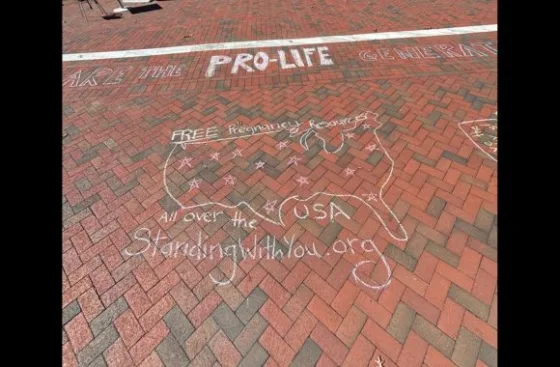
OPINION/ANALYSIS
This article was written by Aneesh Swaminathan, a Johns Hopkins student and president of the College Republicans.
A recent incident at Johns Hopkins University, in which students coordinated via social media to erase pro-life chalk messages across campus, has renewed questions about whether the university’s commitment to free expression reflects the realities of its campus culture.
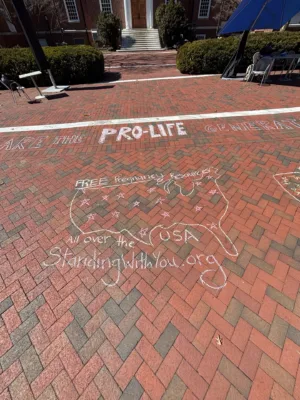
Members of Johns Hopkins Voice for Life wrote phrases such as “We are the pro-life generation,” “Dear lawmakers, protect the most vulnerable,” and “Women’s rights begin in the womb,” alongside drawings of a fetus and links to pregnancy-resource websites at multiple designated locations across campus.
Within two hours, almost all the messages had been washed away or scribbled over.
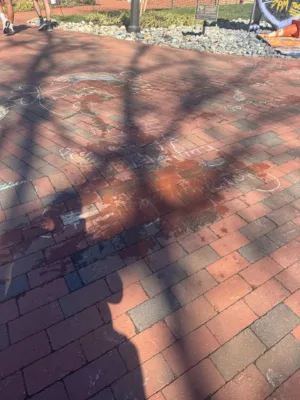
Using Sidechat, a social platform restricted to campus affiliates and popular among undergraduates, students coordinated efforts to remove the messages in real time.
One post stating “F*** whoever drew that pro-life bs outside Levering [Hall]” garnered more than 900 net upvotes on a campus with roughly 5,600 undergraduates.
“Does anyone have chalk? Gonna go scribble over the f***ass pro-life stuff,” one wrote.
Other users shared updates about locations where the chalking had already been removed.
“FFC [cafe] chalk is gone, Levering chalk is partially scribbled over and around. direct [sic] your attention to Levering, I believe the central drawings are mostly still there,” another student wrote.
While many viewed the actions as counterspeech, some noted that erasing expression, rather than responding to it, crosses the line from speech to suppression.
For many conservative, religious, or otherwise heterodox students, the episode was familiar—something understood informally from freshman to senior year, and experienced quietly.
They describe a campus climate in which unpopular views are met not only with disagreement but with open hostility. Despite university-wide announcements promoting civil dialogue and resources on free expression, some students say the risk of backlash, social ostracism, or being publicly identified with unpopular views shapes what they are willing to say, display, or support.
“I feel the need to self-censor, though I still try to speak openly about my views,” said an officer of JHU Voice for Life, who requested anonymity.
“Our messaging is immediately rejected,” she said, adding that classmates often refer to pro-life supporters as “insane” or “archaic.”
Viewpoint-based discrimination and clashes over free expression have challenged JHU Voice for Life for more than a decade.
In 2013, when the group first sought official recognition, the student government denied its application, arguing that its activities could make members of the campus community feel “uncomfortable.” Only after a letter from the Foundation for Individual Rights and Expression did the group receive official recognition.
More recently, the group encountered administrative obstacles in its attempt to host Kristan Hawkins, a prominent pro-life activist and president of Students for Life of America.
According to Voice for Life, the university office overseeing student organizations delayed approvals, reversed prior decisions, restricted advertising, and prohibited filming, ultimately imposing last-minute requirements that made the event difficult to stage. Among those requirements was a speaker contract sent just two days before the event that included a demand for two million dollars in aggregate liability insurance.
Voice for Life is not alone. Other heterodox student organizations report similar experiences on a campus where liberal and progressive students roughly outnumber non-liberal students 11 to 1.
Members of the College Republicans say flyers advertising speaker events are frequently torn down across campus, often within hours. They also pointed to a 2024 immigration event disrupted by masked protesters affiliated with the community organization Hopkins Justice Collective, who shouted vulgarities and set off a stink bomb, forcing the event to end early.
Survey data suggest that these experiences are not merely anecdotal.
Last year, a team led by Andrew Perrin, the Stavros Niarchos Foundation Agora professor and chair of sociology, conducted a campus-wide study of students’ views on free speech and self-censorship.
They found that 32 percent of undergraduates believed it was appropriate to “create an obstruction” to prevent a speaker from addressing an audience; 37 percent supported asking “the school administration to fire a professor who endorses the idea”; and 32 percent believed it was justified to report a student who endorses the idea in class to the university for sanctioning.
They also found a striking partisan divide. Students who identified as liberal, according to the report, “were more likely to endorse these repressive tactics” than those who identified as moderate or conservative. Specifically, 46 percent of liberal students endorsed the idea of “creating an obstruction,” compared to only 10 percent of conservatives.
Furthermore, among these students on the right, 32 percent expressed concern about receiving a lower grade for their views, 42 percent worried about an instructor’s opinion of them, and 64 percent—by far the largest share—feared backlash from other students.
In FIRE’s annual college free-speech rankings, Johns Hopkins fell 25 places last year to 144 out of 257 schools and received an overall “F” ranking for its campus speech climate, despite a modest 0.9-point increase on FIRE’s 100-point scale following its adoption of institutional neutrality. The ranking did not take the Hawkins incident into consideration.
In response to such controversies, the university has sought to clarify its policies.
Ahead of the academic year, the Office of the Vice Provost issued campus-wide guidance on protest in support of free expression, stating that impermissible conduct includes disrupting or interfering with the expression of others, including by defacing or covering flyers.
When asked about recent incidents, the office said that “free expression is a core university value” and that its policies are designed to foster “an environment that is respectful and inclusive, especially when opinions and perspectives differ.”
The office added that the concerns had been shared with the Office of Student Conduct and that the university “take[s] seriously any reports of behavior that may violate the Student Conduct Code or other university policies.”
Whether institutional efforts will lead to meaningful change in the campus culture remains uncertain. For many students whose views fall outside the prevailing campus mainstream, the issue is not simply whether their speech is protected. It is whether speaking at all is worth the personal, professional, or psychological cost.