
 FEATURED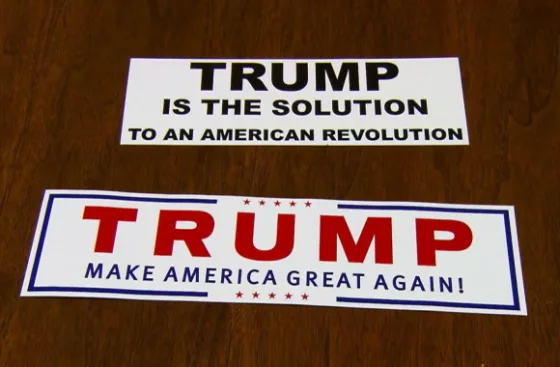
Drivers are far more likely to honk after being cut off by a vehicle bearing a political bumper sticker — especially one from the rival political party, according to a recently published study by University of Cincinnati researchers.
“People are more likely to respond with hostility to bad drivers, if those bad drivers are displaying an out-partisan bumper sticker,” states the article, published in the Frontiers in Political Science journal.
“…From these results, we conclude that bumper stickers are a meaningful way in which partisan divides are reinforced in everyday life and that they have tangible impacts on road safety. Partisan bumper stickers may be mundane, but they are not trivial.”
The research was conducted by University of Cincinnati Assistant Professors Ben Farrer and Rachel Torres. Farrer specializes in studying “how technological innovations can disrupt democratic institutions as well as how these processes have encouraged activism and political mobilization,” according to his faculty bio.
The two scholars did not respond to requests from The College Fix seeking comment.
As reported by Michael Miller of UC News, drivers with vehicles displaying political bumper stickers are more likely to be honked at on the road than drivers without the stickers.
Researchers “found that respondents were significantly more likely to say they would honk at the vehicles bearing political bumper stickers, particularly if the sticker supported their opposing party,” Miller reported.
The logistics behind the study involved paid volunteers witnessing a filmed driving simulation. Half of these simulated videos display a vehicle cutting off a driver from the perspective of the volunteer without utilizing their turn signal. However, what made these vehicles notable was whether or not they displayed a bumper sticker. As Miller reported, “the offending vehicle featured either no sticker or one of three bumper stickers: ‘Proud Democrat,’ ‘Proud Republican’ or the neutral ‘I love my dog.’”
Farrer and Torres provided participants with an animated dashcam film displaying a “sport utility vehicle driving just out of frame” swerving unexpectedly “into their lane briefly before returning to its [own] lane”. What made these films significant was whether or not these offending drivers displayed political bumper stickers.
Participants completed a “five-point scale” survey measuring “how likely they were to honk in their given scenario.”
Farrer and Torres’ study primarily revealed volunteers participating in the driving simulations were more likely to honk at vehicles that cut them off if they displayed a bumper sticker supporting an opposing political party.
For instance, if a volunteer in this study held traditionally liberal, Democratic views, witnessing a car displaying a conservative bumper sticker would provoke these participants to honk. Alternatively, even if an offending vehicle cut off a volunteer participant holding Democratic views, if this vehicle displayed a politically liberal bumper sticker, this participant would be less likely to honk.
So what does this reveal about rising partisanship in recent years? As Torres summarized in her findings, the simulation “activated [participants’] partisan hostilities.”
“We have a unique car culture in the United States. American identity is often tied to owning a car and how you choose to decorate it,” Torres told UC News.
Torres reported to UC News the study confirms the ways in which American car culture has become politicized in recent years. She said that she and Farrer “‘never found bumper stickers to have a positive impact. They didn’t improve people’s perceptions of their group or other groups.’”
A spokesperson with the American Auto Association reported to The College Fix that the AAA recently conducted a study on road rage and aggressive driving. Researchers collected evidence through this study that drivers who display bumper stickers were more likely to engage in aggressive driving habits.
However, the AAA’s study did not isolate the impact of political bumper stickers and reckless driving, differentiating it from Torres and Farrer’s project.
MORE: University of Oklahoma may cut 16 degrees following review by board of regents

