
 FEATURED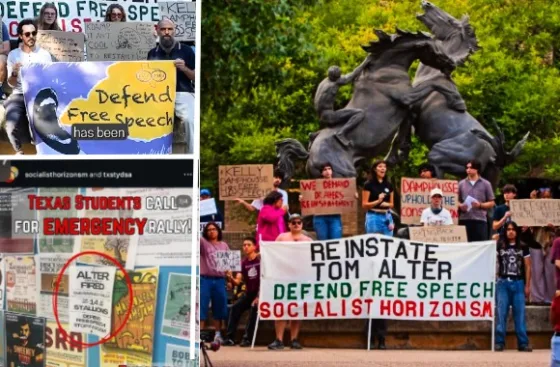
OPINION: Administrative scrutiny, regulatory hurdles fall more heavily on conservative students
Viewpoint discrimination does not always announce itself loudly. Often, it reveals itself through selective enforcement, uneven scrutiny, and institutional tolerance for some forms of activism — but not others.
Texas State University is guilty of this when it comes to enforcing policies with the Young Democratic Socialists of America.
I do not speak on behalf of any organization. I write solely from my own experience as a conservative student who has worked directly with administration and witnessed how policies are enforced.
University policy requires that any group maintain active Registered Student Organization status to function on campus. A core and non-negotiable requirement of that is having an active faculty advisor who will guide the organization morally and methodologically.
Without an advisor, a group is not permitted to hold meetings, table, protest, or host events. Information that the administration has provided to me numerous times explicitly states that the “President and Advisor schedule a meeting with staff to review details, policies, and best practices” before hosting any expressive activity.
Our campus Young Democratic Socialists club lists Professor Thomas Alter as its advisor. Alter was terminated in September after publicly advocating violence against the federal government. Yet, he is still listed as YDSA’s advisor.
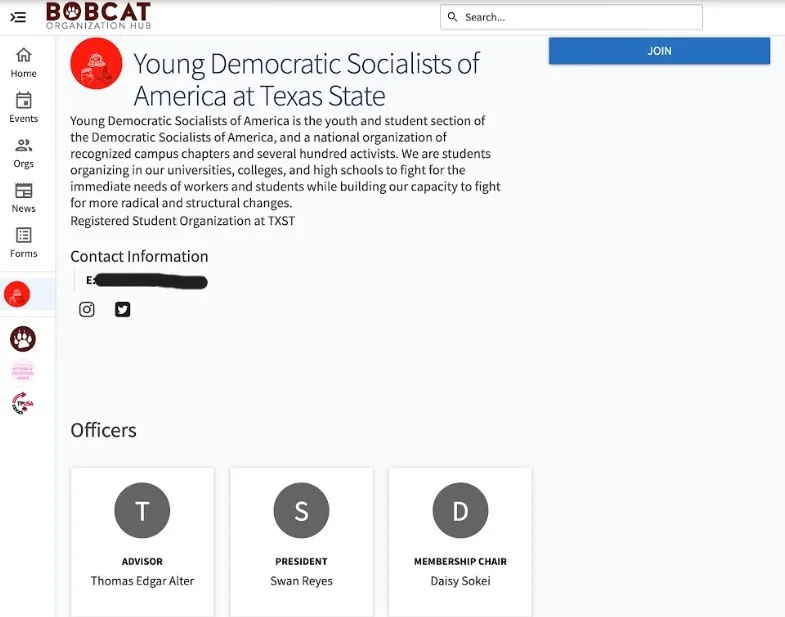
Under the university’s own rules, the absence of an active advisor should prevent YDSA from functioning. Yet it continues to operate.
YDSA has organized repeated protests over the past few semesters supporting Renee Good, Palestine, and Venezuela, and Professor Alter after his dismissal. I saw some escalate into riots that required UPD enforcement. These were chaotic and confrontational events that unfolded in plain view.
Many of these protests were organized overnight and publicly announced the day before they occurred. I personally heard YDSA leadership say that they do not reserve space and simply come out whenever they want — without advance reservation or administrative approval.
They also have erected structures, large signs, and posters on and around The Stallions statue, a campus landmark.
Meanwhile, conservative organizations are seemingly prohibited from placing materials on The Stallions, even during pre-approved events, as per university policy. I know this because I have stood there while administrators enforced that rule against us.
During a pre-approved conservative prayer vigil at The Stallions on Sept. 15, administration ordered us to remove roses and posters. They questioned students about how long we planned to remain. They stopped individuals passing by and asked them to explain why they were present.
In another example of double standards, YDSA has also invited Socialist Horizon of San Marcos, an outside political organization with non-student participants, to campus multiple times to protest alongside them. But all student organizations are required to meet with administration and secure approval before involving outside speakers or organizations. YDSA did not follow that process, I learned.
They also brought Professor Alter back to campus after his termination to participate in protests that were, in part, organized around his reinstatement. He did not simply appear in passing. He spoke and participated in chants and demonstrations alongside students. Under Texas State policy, student organizations must receive advance approval before inviting or sponsoring an external speaker.
In one instance, I saw Alter wearing the same protest tag as other demonstrators that read “will bite.” He was photographed with protesters holding signs and was treated as a focal point of the event.
During these unscheduled protests, administrators and University Police were present. They observed the policy violations, the hostility. The protests continued. Enforcement did not occur.
Yet, when conservative groups reserve space or invite an outside speaker, every procedural requirement is enforced.
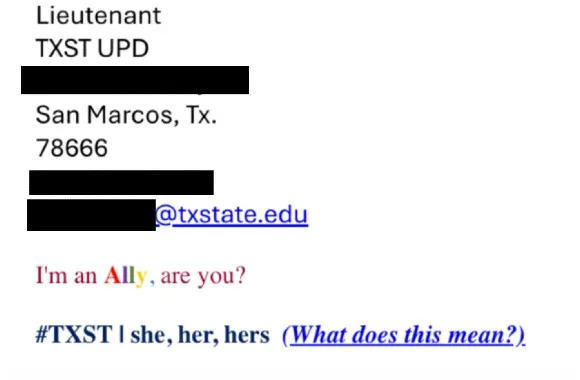
It’s also notable that university police officers regularly conclude official correspondence with the phrase “I am an Ally, are you?” in rainbow lettering, followed by pronouns. Individuals are entitled to personal expression. However, when visible ideological alignment consistently coincides with selective enforcement of policy, questions about neutrality are unavoidable.
Conservative organizations like Turning Point USA and the Network of Enlightened Women, among others, must maintain active advisors, attend approval meetings, provide advance notice, comply with structural limitations, and adhere strictly to procedural rules.
Why aren’t my campus leaders holding YDSA to those same standards? It’s viewpoint discrimination.
Texas State is a public university bound by the First Amendment. Time, place, and manner restrictions must be applied equally regardless of political viewpoint. When enforcement consistently falls along ideological lines, neutrality is not being upheld.
What is happening at Texas State reflects a national pattern across higher education. Conservatives are increasingly reporting that policies are enforced differently depending on ideology. Administrative scrutiny, procedural barriers, and regulatory hurdles often fall more heavily on one side of the political spectrum. Universities may speak of inclusion and diversity, yet ideological diversity is the exception.
If public universities cannot demonstrate consistent, viewpoint neutral enforcement of their own rules, reform becomes necessary. Institutions that receive public funding carry a constitutional obligation to protect speech equally. When that obligation is compromised, trust in higher education decays.
The Texas State situation is part of a broader national inquiry: whether higher education will remain a place where constitutional protections apply evenly, or whether enforcement will continue to depend on who is speaking. Equal protection under the rules is not a partisan demand. It is a constitutional one.
Editor’s note: The university media relations office did not respond to The College Fix when asked for comment about the Young Democratic Socialists of America, its faculty advisor, policies regarding The Stallions, and uniform enforcement of its policies among student organizations. The Fix also contacted the Texas State YDSA, asking about its faculty advisor and compliance with university policies. The chapter did not respond.
MORE: Former atheist neurosurgeon gives ‘case for existence of the soul’ at Cornell

