FEATURED
In the era of Students for Fair Admissions v. Harvard, the national conversation has primarily centered on how affirmative action policies discriminate against Asian and white students.
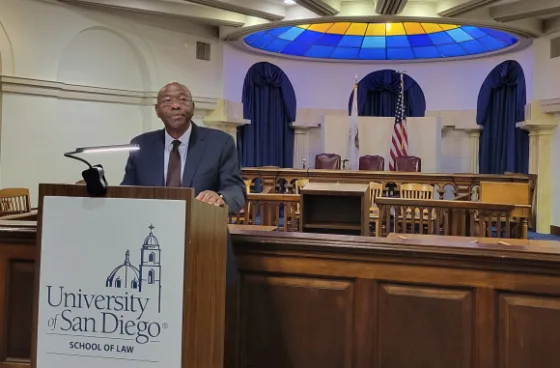
But it’s important to also keep in mind that racial preferences harm their intended beneficiaries as well, argued Manhattan Institute scholar and Wall Street Journal columnist Jason Riley in a talk Tuesday at the University of San Diego School of Law.
“Racial preferences do more than simply violate our Constitution,” Riley said. “Racial preferences are not simply unjust. They also haven’t worked as intended, and in many cases they’ve been counterproductive.”
His one-hour talk cited numerous studies and statistics to spell out how racial gaps in education and income among black Americans were shrinking in the decades before racial preferences in hiring and college admissions.
Riley pointed out that between 1940 and 1960, the black poverty rate in the U.S. fell from 87 percent to 47 percent, prior to both the Civil Rights Act and Voting Rights Act in the 1960s.
“It’s before not only a black president, but also before blacks had any real significant political clout in this country, before black mayors ran big cities with large black populations, before there were majority-black city councils, black school superintendents, and black police chiefs,” he said.
During the 1970s, the first full decade of affirmative action, the black poverty rate continued to fall, “but nowhere near the rate that it had been falling in previous decades,” Riley said.
“Affirmative action has been given credit for a trend that predates its existence,” he said. “The reality is that black people largely lifted themselves out of poverty. It wasn’t due to Lyndon Johnson’s Great Society or to affirmative action, both of which came later.”
Riley, whose latest book is titled “The Affirmative Action Myth,” also flagged educational policies that have throttled black progress.
Black college graduation rates in the U.S. were growing faster before affirmative action policies were invented, he said. As colleges began compromising their admission standards in the late 1960s to admit greater numbers of black students, their graduation rates slowed, he said.
“After 1970, the relative rate at which blacks were completing college dropped, then flatlined, and never recovered its previous upward trajectory,” he said. “In fact, today, after more than 50 years of racial preferences in higher education, blacks are completing college at a lower rate compared to whites than they were in 1970.”
The problem centers in part on what’s called “mismatch,” Riley said.
“When black students get admitted with lower qualifications than other students, they tend to do less well academically,” he said. “It’s not a question of innate ability. It’s a question of being matched properly at the school with a pace of teaching that fits the student’s level of academic preparation.”
Riley cited a study of admitted black students at MIT who had SAT math scores in the top 10 percent of all students nationwide, yet fell into the bottom 10 percent at MIT.
“Nearly 25 percent of them failed to graduate,” he said. “So students who likely would have thrived in a less selective school found themselves struggling, all in the name of diversity.”
“When students are admitted to schools where their qualifications significantly lag behind the school average, they’re far more likely to struggle, drop out, and switch to easier majors,” Riley said, adding the end result is fewer black doctors, lawyers, architects, and engineers.
The argument that racial preferences allow underprivileged minorities to attend better institutions, where they’ll presumably get a better education, is also “a dubious assumption,” he said.
He cited a study comparing black law school graduates at George Mason University in Virginia with those at Howard University, a historically black school in Washington, that reviewed which students passed the bar exam on the first try.
“Even though George Mason is a more selective law school than Howard and used racial preferences to admit students, less than a third of their black law students passed the bar on the first try. At Howard, which doesn’t use affirmative action, the passage rate was more than half, 57 percent,” Riley said. “So ask yourself: Did those black students who were admitted to the more selective school under affirmative action really get a better education?”
Riley also noted affirmative action tends to help black students “who are already better off, even though it’s sold in the name of helping the black underclass.”
“That’s one of the reasons I think you saw black elites complaining about the Supreme Court decision, it was really personal in many ways for them,” Riley said. “A lot of critical race theory comes out of law schools, with minority legal scholars coming up with arguments for why race should be used as a credential in hiring and promoting in law schools. How far are you downstream from impoverished black people there? This is a self-serving policy that they were pushing for themselves.”
During a post-lecture question-and-answer session, Riley added that he also favors ending legacy admissions.