FEATURED

One tenured professor used university credit card for personal expenses but received $175,000 separation payment, according to audit
Troubling findings about a lack of accountability for tenured professors in a recent audit by the Utah Office of the Legislative Auditor General are prompting state higher education officials and lawmakers to consider reforms for public universities.
The Utah System of Higher Education is working with legislators on a potential restructuring of tenure, its media relations office confirmed in a recent email to The College Fix asking about the audit.
“USHE is working with Utah’s elected officials and our institutions to manage these processes and maintain excellence in public higher education. Together, we are focused on offering quality teaching and value to students while protecting due process and the academic freedom tenure supports,” it stated.
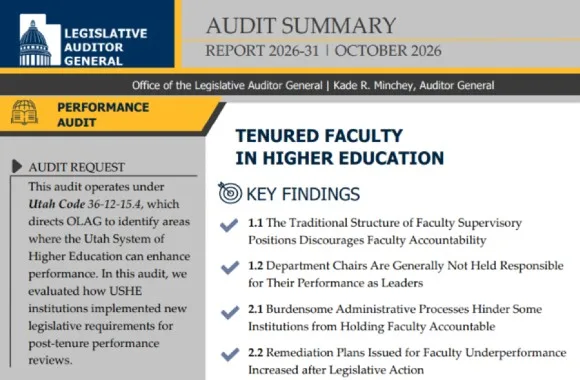
The legislative audit, “A Performance Audit of Tenured Faculty in Higher Education: A Case for Improved Accountability,” published Oct. 20, examined more than 650 post-tenure reviews across Utah’s eight public universities and included over 120 interviews with administrators, deans, and department chairs.
Of those reviews, auditors identified 40 cases where tenured professors received passing evaluations despite documented performance concerns. In contrast, only eight cases found teaching performances unsatisfactory.
One professor “was unresponsive to students’ and colleagues’ requests for five consecutive years,” per the audit. However, the professor’s supervisor said “protections in place for underperforming faculty slow down attempts to
address” the problem. The institution ultimately issued an “Intent to Reprimand” letter, according to the audit.
In another case, a department chair warned a professor for four years that their teaching fell short of the required standard but continued assigning passing ratings. In the fifth year, a review committee identified “significant concerns regarding teaching.” Still, the professor was rated as meeting guidelines.
Additionally, the audit found some institutions paid professors to leave their positions rather than proceed with lengthy disciplinary proceedings.
The audit reports that one professor who repeatedly used a university credit card for personal expenses received a $175,000 separation payment. Another professor who was repeatedly hostile toward colleagues received a semester’s salary and an additional $34,000 to leave.
Another example from the audit cited student complaints about a professor being “aggressive, cruel, humiliating, vulgar, and intimidating.” And while “the supervisor concluded the conduct violated policy, the performance review did not require a remediation plan,” the audit found.
The report does not name the professors or their respective institutions. However, the audit did mention Utah State University is not complying with state review requirements.
According to the audit, the problems partly stem from the traditional department chair model, in which professors temporarily supervise colleagues before returning to regular faculty positions. The audit reports that among the department chairs interviewed, 67 percent expressed concerns about their position’s “authority, workload, incentives, or training.”
The audit also found that “burdensome administrative processes hinder some institutions from holding faculty accountable” for wrong doing.
As a result of these concerns, the audit makes several recommendations. One is that lawmakers consider establishing a maximum timeline for professors to improve after receiving remediation plans. Additionally, the report recommends that the Utah Board of Higher Education strengthen the department chairs’ supervisory authority and establish performance standards for department leaders.
In a response included in the audit, the Utah System of Higher Education agreed with the recommendations regarding department leadership and outlined plans to present proposals for reform in early 2027.
One outside scholar who spoke with The College Fix suggested another solution: take more steps to identify the bad performers before granting tenure in the first place.
“Bad teaching never sets in only once a scholar is granted tenure. You can see a terrible classroom professor coming down Fifth Avenue,” Georgetown University Professor Jacques Berlinerblau told The College Fix.
“So, one way to prevent tenured professors from being awful pedagogues is to not grant tenure to awful pedagogues,” he said in a recent interview.
Berlinerblau, author of the book “As Professors Lay Dying,” frequently writes about higher education issues. A strong advocate for tenure, he believes it is an important element in protecting academic freedom.
He emphasized that improving classroom performance requires an institutional culture that rewards good teaching, including graduate programs that prepare future professors to educate undergrad students.
And notably, the Utah audit included an “Encouraging Cases” section giving examples of effective instruction under tenure. In one case, the audit cites a professor’s student evaluations improved significantly after being required to work with the institution’s teaching center.
“Good college teaching is difficult and it takes years of experience to do it right. But more importantly, it takes an institutional culture that values and rewards good teaching. What I see in these various initiatives is an attempt to punish bad teaching,” Berlinerblau said.
He said universities need rigorous teaching standards and research-based faculty development programs.
Moreover, Berlinerblau told The Fix, “As I argued in ‘As Professors Lay Dying,’ that culture is inculcated in graduate school and the graduate schools are often elite citadels. Graduate school — that’s where we learn to disregard teaching, that’s where the infection sets in.
“So the fix is a long term project: incentivize graduate schools to teach doctoral students how the complicated and specialized things they study can be conveyed effectively to non-specialists,” he said.
The College Fix also contacted the American Association of University Professors and the Utah House Republican Caucus for comment on the audit’s findings and tenure reforms, but neither responded.
MORE: Iowa senator wants to end tenure at state universities