
 FEATURED
School says it will update description, but no changes have been made
A law school faculty fellowship for “candidates of color” is open to all applicants, the University of Wisconsin-Madison told The College Fix in response to questions.
The William H. Hastie Fellowship offers “aspiring scholars” $75,000 per year for two years so they can focus on building up their academic profile. Among its most prominent graduates is Kimberlé Crenshaw, who pioneered Critical Race Theory.
A listing on ProFellow, a database for graduate students, suggests non-white people will be favored during the process.
“The two-year law school Fellowship reflects a commitment to diversity and inclusion in the legal profession and especially encourages applications from candidates of color and other underrepresented communities in the legal academy,” the description states.
This differs from the current description on the university’s website, which reads:
The Fellowship reflects the Law School’s commitment to creating opportunities for people who might not otherwise have the chance to become law professors. It began as an effort to address discrimination and the lack of diversity in the legal academy.
Reached for comment, the school says its own website “accurately describes the William H. Hastie Fellowship, which is open to all qualified candidates, as the description clearly states.”
“The listing from ProFellow does not accurately list the criteria for the program,” Jennie Broecker, the associate director of communications for the law school, told The Fix on May 15. “We are requesting that ProFellow remove or correct the information on their website.”
The ProFellow description still lists the “candidates of color” preference as of May 26, when The Fix checked.
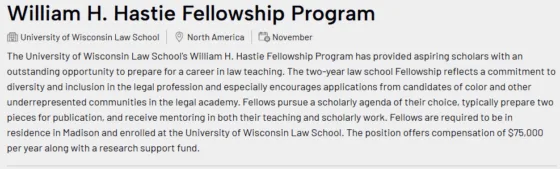
The school has included racially discriminatory language in recent history. In February 2023, the law school described the program as “a leader in guiding and increasing opportunities for lawyers of color and other underrepresented communities to become law professors.”
However, ProFellow’s description appeared verbatim on UW’s own official website as recently as September 2023—less than three years ago.
Archived versions of the Hastie Fellowship webpage show that the “especially encourages” language was consistent from at least 2020 through September 2023. This time frame means that, in the past, UW used a racially discriminatory description longer than it has used the current race-neutral one.
The language is reflected in its selection of fellows.
A College Fix examination of all previous fellows found that the UW-Madison Law School has never accepted a white male candidate into the program.
Of the 48 unique fellows selected over the program’s 53-year history, 47 identified as or were identifiable as minority candidates — only one, a white woman who served from 2022 to 2024, was not a person of color.
A civil rights attorney criticized the university’s use of racially discriminatory language.
“I see this as trying to pay lip service to the [Equal Employment Opportunity Commission] guidance that encourages employers to post jobs widely or to encourage diverse candidates to apply,” Shawna Bray told The Fix via a phone interview.
“I do think it crosses a line when it says, ‘especially encourages,’” Bray, general counsel with the Center for Equal Opportunity, said. This wording “raises a red flag,” Bray said, “and it’s probably why they seem to have deleted it.”
Several recent Supreme Court cases may have contributed to the change in language.
Students for Fair Admissions v. Harvard struck down race-based considerations in college admissions as unconstitutional under the 14th Amendment in a 2023 decision. Two years later, Ames v. Ohio Department of Youth Services affirmed federal civil rights law applies to members of majority groups as well as minorities.
“Ames clarified what has always been true under the Civil Rights Act, which is that you cannot discriminate against the majority any more than you can discriminate against a minority,” Bray said.
She said the Supreme Court allowed for a “little carve-out” for racial discrimination in higher education, which then people “mistakenly” believed “also applied to employment decisions,” Bray said.
“That was never okay. Never allowed. Never legal.”
Hastie Fellowship began as DEI hiring initiative
The Hastie Fellowship’s racial focus was not incidental—it was its original purpose. Since its founding, the program’s mission has always been to increase minority representation in the legal academia.
Confirmed this in a 2013 Wisconsin Law Review article, “The Hastie Fellowship Program at Forty: Still Creating Minority Law Professors,” the program’s mission has always been to increase minority representation in the legal academia.
The author, Thomas Mitchell, was a Hastie Fellow in 1994–1996 and former faculty chair of the Hastie Fellowship Committee.
He wrote that Professor Jones created the program in 1973 “[t]o provide advanced legal training to exceptional minority students to quality [sic] them for, and encourage them to undertake, the teaching of law.”
Professor Jones’ autobiography shows that the program’s original name was “The William H. Hastie Minority Teaching Fellowship Program.”
As Mitchell writes, “By his [Jones’] actions, he showed us what it means to be a law professor who makes a real difference within and outside of the academy.”
MORE: Professor calls for discrimination against white faculty applicants

