FEATURED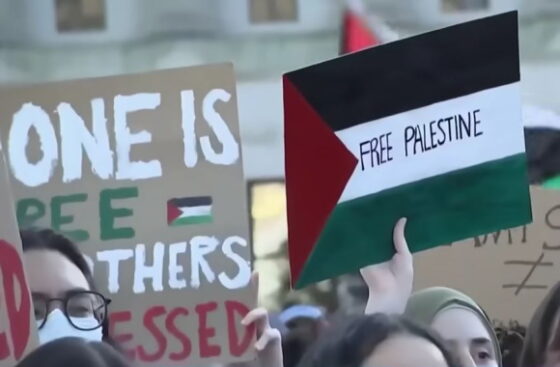
Key Takeaways
- Students for Justice in Palestine at the University of Missouri is suing the university after being barred from including the banner 'Stop the Genocide' in a homecoming parade, claiming this violates their free speech rights.
- The university cited safety concerns due to previous disturbances involving SJP groups, but critics argue this decision reflects discrimination against pro-Palestinian viewpoints, as other political messages were allowed.
The University of Missouri has been sued by its Students for Justice in Palestine chapter, which accuses campus leaders of violating their free speech rights by not allowing them to include “Stop the Genocide” signage in the homecoming parade.
The lawsuit asks a judge to declare that MSJP’s exclusion from the 2024 homecoming parade was unconstitutional and for protection from the university banning the group from the upcoming 2025 homecoming parade.
According to the complaint, the student group in 2024 planned to “perform traditional Palestinian dances, hand out bracelets and candy, and hold two banners that respectively read ‘Ceasefire Now’ and ‘Stop the Genocide’” as part of the parade.
Chancellor Mun Choi, president of the University of Missouri system and Chancellor of Mizzou, allegedly took exception to the second banner’s message, and requested the removal of the term “genocide.” MSJP refused and was barred from participating, the complaint alleges.
The chapter filed suit with the help of the Council for American-Islamic Relations, or CAIR, the largest Muslim civil rights advocacy group in the nation. Its spokesperson Ahmad Kaki told The College Fix that the “genocide in Gaza as despicable,” and believes MSJP has the right to express that message.
“We believe this is clear viewpoint discrimination,” Kaki said, adding the “First Amendment is what allows people to criticize the government.”
“The consequence of allowing the government to decide what speech is good and what speech is bad is that, eventually, you’ll be next.”
Echoing the lawsuit, he told The College Fix that “the only message that Dr. Choi did not allow in the parade was the students’ pro-Palestine message that was critical of Israel.”
Permitted displays included pro-life, pro-Isael, and pro-Trump banners and floats, he said.
University spokesperson Christopher Ave told The College Fix that the “University of Missouri made the decision to deny MSJP’s application . . . to ensure the safety of participants and spectators.”
“Significant disturbances had occurred across the country at other campus events involving Students for Justice in Palestine groups,” Ave said.
“We have also noted concerning actions of some MSJP members at campus events … which among other things have resulted in a senior leader of the group being trespassed from campus for verbal abuse and stalking.”
Despite the university’s reasoning, multiple student groups, including Mizzou’s Young Democratic Socialists of America, the Legion of Black Collegians, and Progressive Jews of Mizzou, issued a joint letter condemning the university’s decisions for “reflect[ing] a deeper problem at Mizzou – a culture of systemic, Islamophobia, and anti-Palestinian hate.”
MSJP and its fellow campus groups did not respond to The Fix’s requests for comment.
Pro-Palestinian groups are faring well in courts, with the University of Pittsburgh’s SJP chapter recently reinstated by a district judge.
According to First Amendment experts, universities such as Mizzou cannot single out individual messages for discrimination.
“Public universities may not discriminate against a student group based on the group’s views, mission, or expression,” Haley Gluhanich, a spokesperson for the Foundation for Individual Rights and Expression, told The College Fix. “Doing so is an egregious form of censorship that violates the First Amendment.”
“When a university has safety concerns, the university must meaningfully try to protect a speaker’s expressive rights by removing or limiting those safety concerns,” Gluhanich said via email.
“If safety concerns still exist that result in the university needing to restrict a speaker’s expressive activity, then the university owes its campus community full transparency as to what specific safety concerns it has and what actions it took to address those concerns before the restriction occurred.”