Danielle Charette - Swarthmore College

A group of students at Swarthmore College have filed a formal complaint with the federal government that alleges administrators mishandle and under report sexual assault crimes on campus.

Swarthmore is the latest in a growing list of institutions across the nation to be hit with claims of administrators sweeping various sexual assault crimes under the rug.

The students behind the Swarthmore College complaint allege campus officials have failed to comply with the Clery Act, a 1998 statute that requires all universities receiving federal student loans to disclose criminal behavior that occurs on or near campus.

Concerned that Swarthmore’s administration has not adequately addressed allegations of sexual assault, Mia Ferguson and Hope Brinn, two Swarthmore sophomores, filed the complaint April 18 along with the testimonies of 10 other students. It will be reviewed by the Department of Education in the coming weeks.

In filing their complaint, Ferguson and Brinn consulted with two 2011 graduates of the University of North Carolina at Chapel Hill who spearheaded a similar complaint against their campus, also citing the Clery Act.

Ferguson, Brinn and the other 10 students claim campus officials persistently under report incidents of sexual battery, sexual assault, and rape; and that some victims are harassed and intimidated, among other allegations.

A recent article in The New York Times describes Brinn’s situation, in which a “fellow student repeatedly sexually harassed her and broke into her room in the middle of the night.”

“Ms. Brinn … said that college administrators tried to dissuade her from making a formal complaint, made light of what had happened, said that she was partly to blame, and in their official records, inaccurately described her allegations to make them seem less serious,” the article states.

The students’ formal allegation against Swarthmore arrived just three days after the college’s president, Rebecca Chopp, announced she and the dean of students, Liz Braun, would pursue an external review of Swarthmore’s procedures, policies and sanctions dealing with sexual misconduct.

In an April 15 campus-wide email, Chopp stated: “[W]e have zero tolerance for sexual assault, abuse, and violence on our campus. It is against the law, it is wrong, and we must all continue to reinforce the message that even one such incident is too many on our campus.”

But Brinn told Swarthmore’s Daily Gazette that an external review was “insufficient,” citing more “systemic” issues. Ferguson said she wishes to frame the issue of sexual assault within “a national movement.”

That “movement” seems to have had a domino effect, with Swarthmore women consulting UNC graduates, the UNC women consulting women who have made similar complaints at Amherst, and Amherst women drawing upon the work of advocates at Yale.

In fact, the same day Swarthmore students filed their complaint, similar ones were also lodged by students at Occidental College – who also touched base with college women behind similar allegations across the nation.

The complaint against Swarthmore comes during what Chopp has called the “spring of our discontent.”

The semester has been full of student dissent, including a controversial student chalking campaign against supposed “rape culture,” a failed referendum to remove Greek life from the campus, and scheduled commencement speaker Robert Zolleick’s withdrawal from the ceremony after student attacks on his record.

After weeks of contention, Chopp called for a community meeting, where more than 200 students, faculty and staff gathered. Most of the conversation centered on the administration’s response to sexual assault. The meeting was described as emotional and meaningful. Dean Braun admitted she “was really moved.” Unknown to the administration, the Clery complaint was in the works before the meeting.

President Chopp has said she has not seen the official legal complaint yet, but plans to fully cooperate with the Department of Education’s investigation.

Fix contributor Danielle Charette is a student at Swarthmore College.

IMAGE: Sheba Also/Flickr

CLICK HERE to Like The College Fix on Facebook.

{ 0 comments }

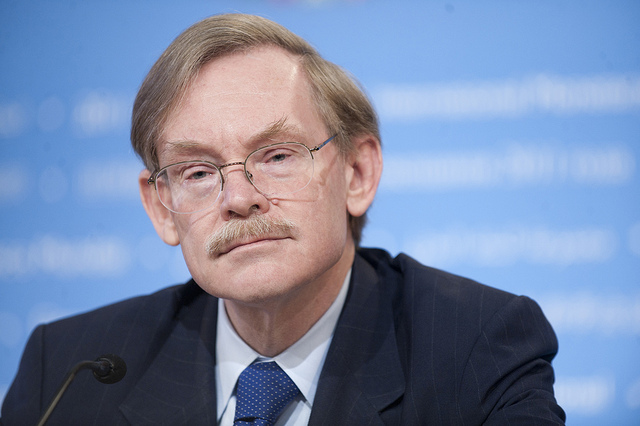
After weeks of intense and sometimes personal attacks on Robert Zoellick and his political reputation by Swarthmore College students, the former president of the World Bank and U.S. trade representative announced he will decline the college’s invitation to give one of its commencement addresses.

Zoellick, who earned his bachelor’s degree with academic honors from Swarthmore in 1975, said in an email to the college’s president that returning to his alma mater for this June’s graduation ceremony – in which he was also slated to receive an honorary degree – was more controversial than it was worth.

Students in recent weeks have called him an architect of the Iraq War, claimed he characterizes Arabs as evil, criticized his stance on free trade, and even called him a war criminal.

Moreover, there were rumors that students would disrupt Zoellick’s graduation speech. Administrators also did little to quell student unrest over his scheduled appearance, nor did they dispute malicious accusations made against his record.

It was all too much for Zoellick.

“I don’t want to disrupt what should be a special day for the graduates, their families, and friends,” Zoellick stated. “Nor do I have an interest in participating in an unnecessarily controversial event.”

Swarthmore President Rebecca Chopp cited students’ protests over Zoellick’s slated appearance as the reason for his cancellation.

“In light of the discussions that have been taking place in the student press over the last week or so, in which the selection of Mr. Zoellick has been the subject of debate, he has informed us that he will neither accept the degree nor participate in the ceremony,” she said in a campuswide email sent Friday.

In the wake of the news, many students on campus Monday and Tuesday said amongst themselves that they are disappointed a vocal and misguided minority ruined an opportunity to hear Zoellick speak, as his views run contrary to much of the day-to-day campus discourse.

Most of the campus controversy had begun with student complaints over Zoellick’s role as an advisor to Bush’s 2000 presidential campaign. Some students also shared concern that Zoellick signed a 1998 letter on behalf of the neoconservative Project for a New American Century in favor of “removing Saddam’s regime from power.”

For that 1998 letter and an article Zoellick wrote titled “A Republican Foreign Policy,” which appeared in Foreign Affairs in 2000, some students smeared Zoellick in campus publications as a “war criminal,” the “chief architect of the Iraq War,” and a man with a “Manichean” view of world power—claims reiterated on Facebook through a student-initiated forum to reconsider Zoellick’s honorary degree.

But the outspoken protestors may have been in the minority.

In a March 28 editorial in the Phoenix, Swarthmore’s weekly student newspaper, junior Tyler Becker argued that “boiling down Zoellick’s impressive public service career to the Iraq War is not only a gross mischaracterization, it’s factually wrong.”

Sam Sussman, a senior and coeditor of the progressive campus magazine Left of Liberal, also pushed back against Zoellick’s detractors.

Sussman said in an email that “after Mr. Zoellick’s less researched critics rightfully retreated from their incorrect accusation that he was ‘an architect’ of the Iraq War, they turned to the more nebulous — and equally erroneous — claim that he ‘characterizes Arabs as evil.’ ”

In an apparent concession that they had exaggerated facts connecting Zoellick to the Iraq War, student activists pivoted to other critiques of Zoellick’s record, namely his position as former U.S. trade representative and his support of free trade agreements.

Swarthmore senior Will Lawrence, who emerged as one of Zoellick’s most vocal critics last month, cited Zoellick’s affiliation with Goldman Sachs and advocacy for free trade in Latin America as reasons to oppose his honorary degree, for example.

Regardless of factual merit, controversy simmered in the campus newspapers for weeks, while the school’s administration and faculty failed to come to Zoellick’s defense.

Indeed, when students against Zoellick’s pending appearance organized a meeting to discuss his record further, campus administrators even sent Alina Wong, Dean of the Sophomore Class and Director of the Intercultural Center, to mediate the conversation.

By the time the meeting took place, the issue seemed to be quieting down, with only about 20 students in attendance. But by then, the campus was firmly polarized on the issue.

A minority of dissenters continued to frame Zolleick as an unacceptable commencement speaker in campus news media. This vocal minority also failed to quell rumors that they might resort to disrupting Zoellick’s portion of the graduation ceremony, though others suggest that they were only planning to protest Zoellick’s presence before his speech, not during the actual event.

Fix contributor Danielle Charette is a student at Swarthmore College.

CLICK HERE to Like The College Fix on Facebook.

IMAGE: World Bank Photo Collection/Flickr

{ 0 comments }

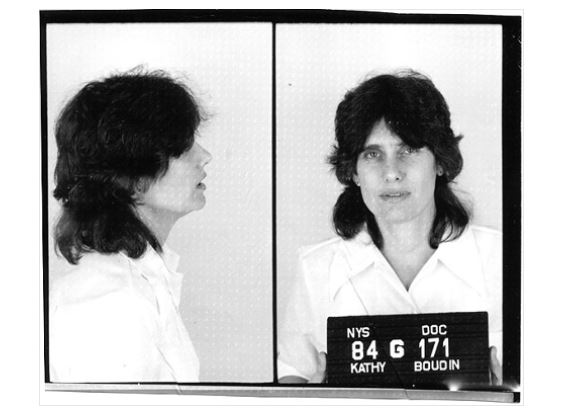
Kathy Boudin, a 1960s radical and former Weather Underground member who participated in a robbery that left two police officers and a security guard dead, now has the prestige of academia behind her.

The New York Post broke the story that Boudin, who spent 22 years in prison for driving the getaway car in the Brinks armed robbery, has been named the Sheinberg Scholar-in-Residence at NYU Law School, along with enjoying an adjunct professorship at Columbia University’s School of Social Work.

Marianne Yoshioka, Associate Dean of Columbia School of Social Work responsible for hiring Boudin, told the Post that Boudin, who teaches on criminal parole and reentry into society, is “an excellent teacher who gets incredible evaluations from her students each year.”

According to Yoshiokia, Boudin has taught hundreds of students at Columbia, with only three ever complaining about Boudin’s radical credentials.

“Of all the people in the world to find to speak on the issue of what women face coming out of parole and reentry, Columbia and NYU had to find a former far-left extremist who has been convicted for the death of three people,” said the Wall Street Journal’s Sohrab Ahmari on Opinion Journal Live.

Boudin’s students may not realize that the Weather Underground was an infamous radical leftist student organization that split with Students for a Democratic Society (SDS) in the late 1960s to join ranks with black liberationists and other self-identifying revolutionaries. Their goal was nothing short of overthrowing the United States government.

Boudin survived the 1970 Greenwich Village townhouse explosion, when a bomb intended for the Fort Dix, New Jersey Army base prematurely detonated and killed Weather Underground activists Theodore Gold, Diana Oughton and Terry Robbins. At the time of the explosion, Boudin was out on bail, awaiting trial for her role in the “Days of Rage” demonstrations in Chicago the year before.

Still living in hiding as a fugitive in 1981, Boudin played a central role in the Brinks heist, which was supposed to usher in a new American revolution but instead ended with three dead. At the time of the robbery, Boudin was 38, married, and the mother of a toddler.

Boudin isn’t the only 1960s terrorist to earn the prestige of the academe.

Northwestern Law School employs Bernardine Rae Dohrn, a founding member of the Weather Underground and a principal signatory of the group’s 1970 “Declaration of a State of War,” which announced violent conflict with the U.S. government. Dohrn’s husband, Bill Ayers, one of chief theorists of the Weather Underground’s communist agenda, has held a “distinguished” professorship for many years with the College of Education at the University of Illinois at Chicago.

Why would universities open their classrooms to former American terrorists?

Ahmari speculated that “the culture treats people that are on the Left and extremists as, ‘oh, it was the 60s and 70s and these kids were basically well-intentioned and the system was terrible back then and sure they went too far every once and a while but they’re basically on the side of the good and the just.’ ”

Boudin’s victims might have a different definition of justice.

Fix contributor Danielle Charette is a student at Swarthmore College.

CLICK HERE to Like The College Fix on Facebook.

{ 0 comments }

A well respected UC Santa Barbara sociology professor in a recent lecture blamed nearly everything but personal responsibility for the high crime and incarceration rates that have long plagued black and Latino communities.

“We need to take accountability for what the state and government has done,” said Dr. Victor Rios during his Feb. 21 guest address at Swarthmore College. “Officers are still beating down black and brown kids.”

And U.S. law enforcement is overtly radicalized and “hyper-masculine,” said Rios, a highly regarded sociologist among leftist academic circles. Rios, a self-described former gang member who eventually turned his life around and earned a Ph.D. from UC Berkeley, has won several awards and grants, has been featured in many news reports, and often gives motivational speeches at schools.

Rios’ address at Swathmore was given not only to college students, but visiting school children as well. He told them he finds fault not only with police, but also politicians and the public, for the high amount of black and Latino incarceration rates, saying people’s fear of “radicals like Malcolm X” is a factor. Rios added the school-to-prison pipeline can be linked to the way some Americans label young people.

“It’s not a question of whether black and Latinos are more prone to crime, but how we choose to label them,” he said. “How you label someone determines how you treat them.”

With that, the term “at risk” becomes almost a self-fulfilling prophecy for inner city youth, he said.

Rios neglected to speak on what role, if any, he believes personal choice, the drug trade, or family lifestyles in high-crime communities has played in those statistics.

And while he focused on the rising number of incarcerations since the 1960s, he did not address Bureau of Justice Statistics stats that the violent crime rate has been on a steady decline since 1973. Rios isn’t a fan of jail, anyway. He said he prefers “restorative justice.”

His 2011 book, Punished: Policing the Lives of Black and Latino Boys, “analyzes how punitive juvenile crime policies and criminalization affect the everyday lives of urban youth,” according to his website.

In his speech, Rios said he aims to couch his goals in language that most people can understand. Conservatives, he noted, are excellent at this: “They don’t say they hate black people; they say that welfare makes people lazy.”

Rios’ talked was dubbed “Consequences of Mass Incarceration of Black and Latino Boys” and sponsored by a plethora of Swarthmore groups and academic departments, including:  the Black Cultural Center, Latin American Studies, Gender and Sexuality Studies, the Dean’s Office, the Provost and President’s Offices, the Queer and Trans Conference, and the Political Science, Sociology and Anthropology, Psychology and Educational Studies departments.

Rios, a former Oakland gang member, has come full circle, he told the audience. In a 1994 PBS Frontline documentary on the high school dropout rate, Rios was personally featured as a dropout and delinquent. The documentary shows footage of him being forcibly detained by two officers in a high school hallway. Now a Ph.D. sociologist and “social justice” advocate, Rios is a dynamic speaker.

In his lecture, he went out of his way to encourage visiting Chester, Pa., school children in the audience, saying: “I look forward to you being in college someday … and maybe even being your professor.”

While Rios’ argument was offered with zeal, others scholars have poked holes in ideas behind his beliefs.

For example, Heather MacDonald, the John M. Olin fellow at the Manhattan Institute and an outspoken advocate for New York City’s so-called “stop-and-frisk” policing strategy, wrote in The Wall Street Journal in January that “the advocacy community sees only racism in the fact that the bulk of trespass and other stops happen in minority neighborhoods.”

“But that racism charge,” noted MacDonald, “ignores the statistical truth that crime, too, is disproportionately concentrated in those neighborhoods.”

Rios did not cite the demographic makeup of the neighborhoods he studies and kept his remarks mostly to abstract complaints about “The System.”

“I’m assuming most of us in here are progressive,” admitted Rios.

Clearly his peers in academia are big fans, based on the number of speeches he gives and accolades he has received.

“Professor Rios’ ambitious research on the factors that contribute to the social marginalization and hypercriminalization of Latino and black men has garnered significant national attention,” stated UCSB’s Verta Taylor, chair of sociology, in a 2012 announcement that Rios was awarded a $300,000 grant to study “how the interactions between gang-associated youth and their parents, school professionals, police, and probation officers affect their identity and criminal behavior. ”

“This new project will provide insight into the important role that parents and other authority figures play in helping young people at risk for gang involvement unshackle themselves from the criminal justice system,” she said. “Rios has a keen commitment to public sociology and is emerging as a leading expert on gang process and gang reduction.”

Fix contributor Danielle Charette is a student at Swarthmore College.

CLICK HERE to Like The College Fix on Facebook.

IMAGE: Side One Cincy/Flickr

{ 3 comments }

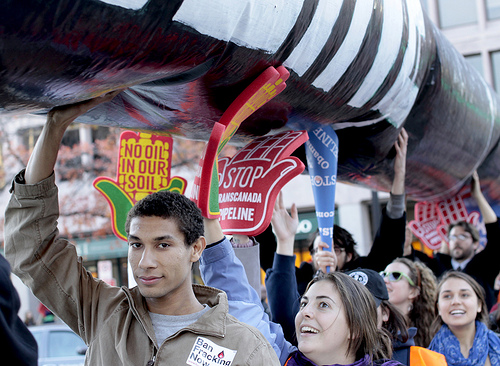
While Swarthmore College officials have not budged on student demands for endowment “divestment” from oil companies, its President Rebecca Chopp has extended student activists and members of its Mountain Justice Club quite the olive branch: chartered buses to the President’s Day Tar Sands protest against the Keystone XL pipeline.

Green groups at Swarthmore, like those at Harvard, Cornell, Middlebury and other private universities, have been ratcheting-up the call for their colleges’ to pull endowment investments out of the fossil fuel industry.

Though Swarthmore is unlikely to play games with its $1.5 billion endowment, funding for the anti-Keystone rally, scheduled for Feb. 17, comes directly from Swarthmore President’s Office, an indication administrators will not shy away from aligning with an environmentalist movement on the Left when they can.

Some have speculated the move is also an apparent appeasement effort to students who’ve called for the college to divest from big oil.

This weekend’s protest is slated to take place at Washington D.C.’s National Mall and is billed by organizers as “the largest climate rally in history.”

At the heart of the protest are demands to ensure the Keystone crude oil pipeline – which would ship crude from the oil sands of Alberta, Canada, to refineries in Texas – is never approved by President Barack Obama.

Chopp told the Swarthmore Phoenix that she and the college’s Vice President Maurice Eldridge “have offered support from the President’s Office to pay for a bus to take community members who are interested in participating.”

As many students as possible have been encouraged to attend. An email from Eldridge, addressed to the “full community,” urged students to ”Get on the bus!”

It went on to say: “We’ll have a charter bus to get you from Swat to the President’s Day Tar Sands protest and back again. Join your fellow students and stand in solidarity with thousands from throughout the US and Canada.”

But not all Swarthmore students appreciate this version of green solidarity.

Cole Turner, a member of Swarthmore’s Conservative Society, told The College Fix, “The college community as a whole obviously leans to the left, but they seem to contradict their message of all-inclusion with their silencing of the pro-pipeline minority.”

Turner said he’ll refrain from joining the “militant greenies” in Washington and noted, “an institution of higher education should focus more on opening the minds of their students rather than indoctrinating them against a project that would economically benefit the nation as a whole.”

The Student Budget Committee, overseen by students, usually distributes funds for club trips and similar endeavors. Technically, the Deans’ Office will sponsor one conference per student per year.

The President’s Office, however, usually only sponsors major academic initiatives or events that reflect the whole campus. But the assumption that the Keystone Pipeline protest is an appropriate campuswide initiative is offensive, according to some conservative students.

Some have also argued it’s a means of quieting the school’s divestment movement, which made the front page of the New York Times in December and has since given campus administrators plenty of reason to hand wring, as students demands have not been squelched despite administrators’ refusal to divest.

Fix contributor Danielle Charette is a student at Swarthmore College.

IMAGE: TarSandsAction

Click here to Like The College Fix on Facebook.

{ 3 comments }

A Supreme Court decision on whether universities can use race as an admissions factor is expected by June, however the court of public opinion has already weighed in on the matter – and Americans of all stripes stand largely against affirmative action, according to a variety of recent polls.

In those surveys, at least half if not more of those polled voiced opposition to race-based preferences.

Take a Rasmussen national telephone survey, which found only 24 percent of likely voters were in favor of using race as a factor in college admissions, while 55 percent stood opposed, and the rest were undecided. That survey was conducted 11 months ago.

More recently, a survey released in October found that 57 percent of Americans ages 18 to 25 – so-called young millennials – are opposed to racial preferences in college admissions or hiring decisions. In other words, nearly six out of every 10 opposed the practice.

“Although most younger millennials are firmly opposed to affirmative action programs in college admissions, relatively few report that they were hurt in the college admissions process because of their race or gender,” states a report on the results of the survey, conducted by the Berkley Center for Religion, Peace, & World Affairs at Georgetown University and the Public Religion Research Institute.

Results also indicated 47 percent of those in that age group “oppose programs that make special efforts to help blacks and other minorities to get ahead because of past discrimination.”

What’s more, the survey found “support for affirmative action programs diminishes considerably when younger millennials are asked specifically about affirmative action for college admission.”

The same month that survey was released, the Supreme Court heard oral arguments in the case Fisher v. the University of Texas, which deals with race-conscious college admissions in America’s public universities.

Most of academia has expressed support for the University of Texas, which aims to continue its practice of using race as a preferential factor in admissions decisions. Administrators and faculty at elite schools have also chimed in, defending the notion of “diversity” in the classroom. All members of the Ivy League, the nation’s top liberal arts colleges, and other big-name schools, have filed amicus briefs on University of Texas’ behalf.

Yet the higher education community’s overwhelming support for racial preferences is not mirrored by the general public.

This month, the American Enterprise Institute released a political report that compiled public opinion on a variety of issues, including affirmative action. In its publication, the organization cited data from a 2010 survey by the National Opinion Research Center which found that a vast majority of Americans – 81 percent – oppose affirmative action policies that favor African Americans.

What’s more, only between 44 and 62 percent of blacks polled voiced support for various minority preferences, the poll found. AEI’s public opinion analyst Karlyn Bowman notes, in an interview with The College Fix, that results on such a sensitive topic are always swayed by how pollsters’ frame the question.

Nevertheless, she points to perhaps the most consistent of all affirmative action data available, an annual survey by the UCLA-based Higher Education Research Institute. The poll has found that, since 1995 and every year since, roughly 50 percent of college freshmen believe race-based university admissions preferences should be abolished.

“You could balance a glass of water on that line it’s so flat,” Bowman says.

Fix contributor Danielle Charette is a student at Swarthmore College.

Click here to Like The College Fix on Facebook.

IMAGE: Donkey Hotey/Flickr


{ 7 comments }