FEATURED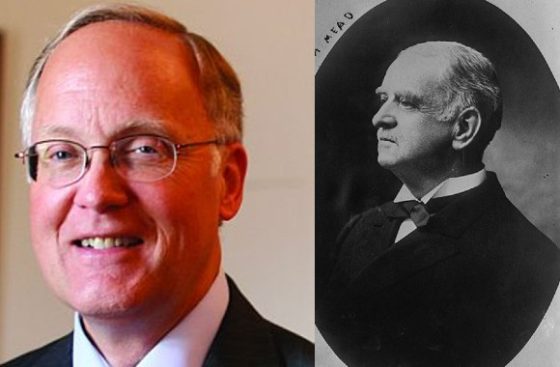
Key Takeaways
- The estate of former Vermont Gov. John Mead is appealing a trial court decision that upheld Middlebury College's decision to remove his name from a chapel.
- Middlebury College argues the removal is justified based on historical context, including references to eugenics in Mead's record, while the estate contends the chapel was built as a lasting memorial without an end date for the naming.
- The appeal includes claims of breach of contract and good faith, while 10 other colleges are supporting Middlebury and arguing the estate lacks standing, claiming discussions on gift law should involve the state attorney general.
UPDATED
The legal battle over Middlebury College’s decision to remove the family name of a former Vermont governor has now moved to an appeal before the state supreme court.
After losing in trial court earlier this year, the estate of Gov. John Abner Mead, represented by former Vermont Gov. James Douglas, filed an appeal.
The estate’s attorney argues the trial court made a series of flawed rulings during the earlier proceedings in 2024, limiting the estate’s ability to present evidence and legal arguments. The Vermont trial court had dismissed all claims in April of 2025.
The court sided with the college’s argument that there was no explicit contract guaranteeing the Mead name in perpetuity.
The court also accepted Middlebury’s position that its evolving understanding of Governor Mead’s (pictured, right) historical record includes a 1912 reference to eugenics, justified the name removal.
The university argues it has fulfilled its promise to Governor Mead by allowing the chapel to be named after his family for more than 100 years. The former governor’s estate argues the agreement had no end date.
Douglas (pictured, left), the administrator of Mead’s estate, wrote in an email to The College Fix: “The structure that John Mead built was both a Memorial and a Chapel, and memorials have no end-date; they are always meant to be for as long as the memorial stands. The trial judge simply picked an arbitrary duration and declared that sufficient. No Vermont statute exists that applied to our case.”
This September 2025 appeal is on the grounds of breach of contract, breach of good faith and fair dealing, and promissory estoppel. Douglas dropped the claim for breach of a conditional gift.
This follows the original 2023 lawsuit when the estate sued the college after it removed Mead’s name from its campus chapel and renamed it “Middlebury Chapel.”
The original lawsuit accused the college of engaging in cancel culture by mischaracterizing Mead as a eugenicist based on a 1912 speech. Douglas argued the decision violated the donor’s original intent and erased an important part of the college’s history.
Mead, in his Farewell Address of 1912, expressed support for studying “the use of a new operation called a vasectomy,” as The Fix previously reported.
Middlebury College media relations did not respond to multiple requests for information via email and voicemail. The Fix asked about the college’s appeal to gift law, its justification for removing Mead’s name given the school’s own ties to eugenics, and concerns donors might not support the school.
Mary Grabar, who runs the Dissident Prof website, told The Fix via email: “This seems to be part of a pattern in re-namings, where an individual is chosen to signal the awareness of woke academics, administrators, and politicians of political sins, even when such individuals have engaged in practices common to their time–such as slavery.”
Ten other colleges are currently supporting Middlebury, arguing the estate lacks standing. The colleges argue that gift law disagreements lie with the state attorney general.
But there’s a problem, according to Douglas.
“Gov. Mead did not ‘donate’ the money – he actually built the Chapel,” Douglas said. “[W]e are not arguing Gift Law.”
Douglas also noted that of the colleges moving for dismissal, seven rank “F” on the Foundation for Individual Rights and Expression’s free speech scale, and at least six have a history of supporting eugenics according to information provided to The Fix by Mead’s estate.
Signers of the amicus brief include Amherst College, Swarthmore College, and Tufts University.
“Middlebury stands alone in refusing to admit its heavy & sustained commitment to teaching eugenics, despite the overwhelming evidence of its complicity,” Douglas said. “Gov. Mead mentioned the topic only once, in a few paragraphs of a lengthy speech in 1912, while Middlebury served as a eugenics factory, training generations of eugenicists for many years. It’s shameful.”
The estate filed an opposition to block the amicus brief on the grounds that the “conditional gift” claim was already dropped; the amicus brief would improperly introduce new facts and policy arguments not presented in the lower court; and under Vermont Rule of Appellate Procedure 29, the colleges’ input is not “desirable.”
The estate moved to deny the colleges’ motion entirely.
The Colleges opposed that: they said Douglas’ argument was “unusual and unfounded.” Instead, their amicus brief will help the justices evaluate the broader national implications of the case.
They also said the brief will simply provide a national perspective and aids for the judge – it would not bring new evidence.
The Vermont Supreme Court has not yet ruled on whether to hear the appeal or accept the amicus brief filed by the ten colleges.
Grabar, the historical expert, said allowing colleges to renege on agreements would harm their fundraising efforts.
“Why give your money to an institution that may implement a smear campaign against you in the future, as is the case with John Mead and his family,” she said.
Editor’s note: The article has been updated with further information about the amicus brief. The name of Middlebury’s chapel has also been corrected and a link to the appeal has been corrected.
MORE: UCLA ‘hate crime’ involving ‘wads of paper’ has ‘no leads’ police say