BUZZ
BUZZ
Even prayer rooms can ‘feel unwelcoming’
A social and political psychology lecturer at University College London says “many” Muslim women have indicated that various “university spaces” make them feel “unsafe, marginalized and out of place.”
In the UCL Institute of Education blog, Amena Amer writes that based on “walking interviews and participatory photography,” she found “for many Muslim women students and staff, university life can involve navigating racism, sexism and Islamophobia all at the same time.”
Even Muslim prayer rooms “could feel unwelcoming,” some said.
Muslim women students and staff spoke about feeling at times highly visible and, at others, invisible: being asked to appear in diversity campaigns or to represent “difference” in a seemingly performative act of inclusion that benefits the institution, while also feeling overlooked in other aspects academic life.
Speaking about injustice, faith, identity or global events often evoked fears of being misunderstood, silenced or disciplined, especially in a political climate that makes many already feel highly scrutinised. People are asked to be authentic but also need to protect themselves. They are asked to contribute to inclusion, but without enough support or recognition of the challenges they, and others like them, navigate.
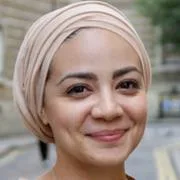
Amer (pictured) also says Muslim female students (and staff) with teaching responsibilities noted they “feel responsible” for advising and mentoring their minority peers, a common refrain among non-white college instructors and activists.
Nevertheless, Muslim women in such positions create “acts of quiet resistance” by “sharing experiences,” offering mutual support, and “speaking honestly.”
To help alleviate such sentiments, Amer says higher ed institutions should create “genuinely” inclusive areas, offer “emotional and academic” mentorships and support structures, and “recognize” that Muslim women’s faith “is part of belonging.”
According to her faculty profile, Amer’s research “explores intersectional identities, experiences of belonging and power asymmetries, and inter- and intragroup dynamics, particularly among minoritised and marginalised groups.”
Other recent posts on the UCL Institute of Education blog include “A decolonial pedagogy: learning, being and becoming,” “A decolonial pedagogy: learning, being and becoming,” and “A decolonial and transcolonial curriculum: an urgent political moment.”
MORE: DePaul restricts access to Muslim Women Matter event critical of forced marriage, genital mutilation