FEATURED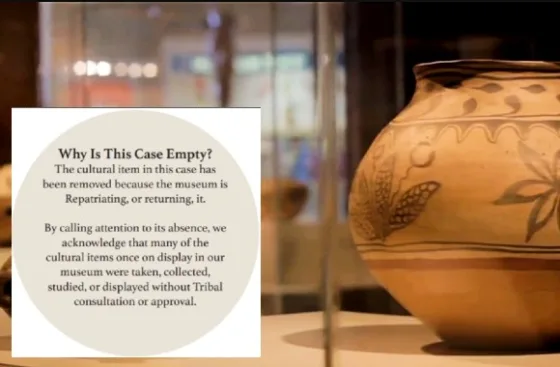
Museums ‘have closed galleries,’ ‘suspended educational programming’ due to federal regulations governing tribal artifacts, lawsuit claims
A new lawsuit by Wyoming archeologists claims federal regulatory overreach is threatening to wipe out “entire archaeological collections” of Native American artifacts at the University of Wyoming.
At issue in the case is the Native American Graves Protection and Repatriation Act, a law originally intended to facilitate the return of human remains and sacred items from public collections to tribal descendants.
However, some scholars say regulatory changes in 2010 and 2024 have led to the repatriation of a much wider swath of items, including photo negatives and corn cobs. And a new emphasis on respecting “Native American traditional knowledge” has prompted campus policies restricting professors from showing images of artifacts in class. One university employee even said staff “visit and talk to” Native American artifacts housed at her public institution because some tribes believe the inanimate objects are “relatives and shouldn’t be left alone.”
The Wyoming Association of Professional Archaeologists is challenging the regulations in its lawsuit, filed at the end of July.
“Since the 2024 regulations took effect, thousands (likely millions) [of] archaeological resources have been unlawfully divested (and continue to be divested) from archaeological repositories,” the lawsuit states.
Additionally, “major museums and repositories have closed galleries, covered display cases, removed or restricted access to Native American cultural materials, and suspended educational programming,” it alleges.
The case names the U.S. Department of the Interior and its Bureau of Land Management, which declined to comment Friday when The Fix asked about the lawsuit.
Meanwhile, Elizabeth Weiss, an anthropology professor emeritus and outspoken critic of the 2024 regulations, welcomed the lawsuit as a “promising challenge” to the federal “overreach.”
“The NAGPRA compromise reached in 1990 when the law passed included that the only artifacts to be repatriated to tribes would be funerary objects, sacred objects, and objects of cultural patrimony,” the San José State University professor emeritus told The Fix.
“Other materials were supposed to remain in universities and museums to enable anthropologists and archaeologists to continue to study the past,” she said.
One key problem with the 2024 regulations is the expanded definition of “cultural items” and “funerary objects,” both Weiss and the lawsuit claim.
“The Wyoming archaeologists are challenging the current incorrect usage of the term funerary objects when it comes to nonhuman animal remains particular to six specific sites,” Weiss told The Fix.
“If the archaeologists win, this could result in those involved in repatriation activities having to follow the law. And, in short, this may be the first legal victory needed to dial NAGPRA back to its original compromise,” she said.
The lawsuit hinges around a situation involving tribal artifacts housed at the University of Wyoming. The case also mentions artifacts in Colorado.
Last year, the Bureau of Land Management informed the University of Wyoming Archaeological Repository that “entire archaeological collections” from several archeological dig sites would be repatriated from the institution.
The collections include “stone tool-making debris,” soil samples, rocks, “campsite refuse” and other things that the original law never intended for repatriation, according to the lawsuit.
If the court does not act soon, the archeologists warned that the bureau soon will take away these items and destroy researchers’ ability to study and learn from them.
Such actions “are the result of the enactment and enforcement of an unauthorized and unlawful regulatory scheme” by the federal government in 2010 and 2024 that rewrites NAGPRA “expanding its reach far beyond the boundaries” of the original law.
The regulatory changes to NAGPRA “injure the public by depriving it of access to, and the educational and scientific benefits of, an irreplaceable material record (developed over more than a century of archaeological investigation, funded in significant part by the United States) that belongs to the American people and is permanently diminished each time a part of it is unlawfully transferred, reburied, or removed from study,” the lawsuit claims.
The lawsuit asks the court to “halt ongoing unlawful transfers” of artifacts and restore the original intent of the law by throwing out the recent regulations.
The archaeology association also emphasizes that the lawsuit is not challenging the original law or trying to reverse any repatriations that already have taken place.
Bonnie Lawrence-Smith, president of the Wyoming Association of Professional Archaeologists, declined to comment and directed The Fix to the association’s lawyers, who also did not respond.
The University of Wyoming Department of Anthropology Chair Melissa Murphy referred The Fix to the university media relations office when asked about the lawsuit and NAGPRA. The office did not respond.
MORE: Indiana U. ‘repatriation’ director: I don’t tell airline when flying with tribal human remains
MORE: ‘We owe it to science’ is ‘unacceptable’: Indiana U. training prioritizes ‘tribal knowledge’
MORE: U. Tennessee restriction on Native American images prompts legal concerns