
 BUZZ
BUZZ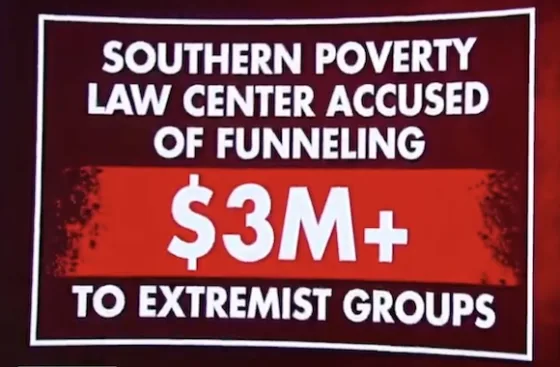
Key Takeaways
- The Southern Poverty Law Center (SPLC) faces serious legal charges for allegedly funding informants connected to White supremacist groups, raising accusations of hypocrisy in manufacturing the extremism it claims to combat.
- The SPLC's activities have influenced various educational discussions and curricula, notably after the 2017 Charlottesville rally, where it was used as a source for teaching materials about racial issues.
- After Charlottesville, the SPLC saw a significant increase in revenue from $51.9 million to $133.5 million, while also facing criticism for its alleged role in inciting division by labeling individuals and groups as extremist without due scrutiny.
ANALYSIS
The Southern Poverty Law Center was indicted this past week on wire fraud charges, making “false statements to a federally insured bank,” and “conspiracy to commit concealed money laundering.”
According to Fox News, the charges stem from “a years-long alleged covert paid informant program” which allegedly “allocated millions of dollars in donations to a network of informants affiliated with or closely tied to White supremacist and neo-Nazi groups.”
These groups include the KKK, the National Socialist Party of America, and a “leader” behind the 2017 “Unite the Right” rally in Charlottesville, Virginia.
Acting Attorney General Todd Blanche said the SPLC was “manufacturing the extremism it purports to oppose by paying sources to stoke racial hatred.”
The Charlottesville march became a major rallying point not only for progressive politicians at every level (especially Donald Trump’s out-of-context “fine people on both sides” quote), but academia cited it seemingly endlessly for “anti-racist” and DEI-related purposes.
For example, a group of University of Virginia graduate students called the Graduate Student Coalition for Liberation created the “Charlottesville Syllabus,” which Wake Forest University then used as the basis for teach-ins on race and racism. Included readings came from … the Southern Poverty Law Center.
“We pay people to be racist so we can fight racism” https://t.co/86X8DNY6fJ pic.twitter.com/pD2SopfutJ
— Flappr (@flapprdotnet) April 22, 2026
The former president of Southern New Hampshire University used Charlottesville to brag about his school’s commitment to “social justice,” including the “inclusivity” of its restrooms and a new initiative “to support refugees and immigrants in [the] local community.” He also claimed counter-protesters at the Unite the Right rally were there merely to “protest the evil that is the alt-right and defend American values.”
The hashtag #CharlottesvilleCurriculum went viral among educators, allegedly starting with Atlantic writer Melinda Anderson and with a big assist from American Federation of Teachers head Randi Weingarten. Anderson posted “public education materials on America’s legacy/history of racial terror” including those from … the Southern Poverty Law Center.
At a Brown University panel discussion, an academic claimed the Charlottesville rally was evidence white supremacy is not “marginal” nor a “leftover fringe ideology […] limited to extremists,” while a history professor said the march “relie[d] on a memory based on a fantasy created by American slaveholders of a perfect system of enslavement.”
SPLC revenue before Charlotesville – $51,871,438
— Andrew Kolvet (@AndrewKolvet) April 22, 2026
SPLC revenue after Charlotesville – $133,463,398
The SPLC paid $270,000 to a Unite the Right Rally leader.
The “hate” grift in a single image. pic.twitter.com/arUggwSkT2
Law professors from the University North Carolina and University of Detroit Mercy argued Charlottesville was “the conspicuous face of a broader and stratified movement” that includes “statesmen [and] CEOs,” and compared Confederate imagery to that of Nazi Germany.
The University of Minnesota used Charlottesville to recommend an SPLC brochure on identifying the “alt-right” and how to counter them.
A year after the Charlottesville march, the University of Virginia group U.Va. Students United declared it would “not let the University continue to erase the events of [the rally] and their complicity in aiding white supremacy.” It offered a “toolkit” to help fight white supremacy because it “DOES NOT ONLY exist in Charlottesville.”
Not to say we told you so, but nobody with a brain actually believed this was real. pic.twitter.com/CfQj8uW5L7
— Kevin Sorbo (@ksorbs) April 22, 2026
Those demonized and harassed about Charlottesville include the former president of the Ithaca College Republicans, a University of Arkansas professor, the Washington State University College Republicans, a Trump appointee to UVA’s Miller Center, a Boise State University professor, and even … Thomas Jefferson.
In addition, a Seton Hall student organization called a professor a “white supremacist” and demanded his firing — for the offense of calling the SPLC a “hate group” and saying Black Lives Matter and Muslim terrorists are more of a threat than the KKK and Neo-Nazis.
There also was the quartet of Ohio University students targeted by the “People’s Justice League” group for flying the “Roman standard” — SPQR — flag, which it claimed the SPLC said was used “as a symbol embraced by ‘many fascist groups.'”
How SPLC’s $520,000-per-year CEO helped turn civil rights group into a ‘partisan smear machine’ https://t.co/fZ6PJQik8Y pic.twitter.com/JSjfUooBAw
— New York Post (@nypost) April 23, 2026
Months before the Charlottesville chaos, the media made use of an SPLC report which alleged a jump in hate crimes just one month after Donald Trump’s 2016 election.
According to the report, roughly 4,000 educators claimed to “have heard derogatory language directed at students of color, Muslims, immigrants and people based on gender or sexual orientation” — 867 of which occurred just 10 days after Election Day, then-SPLC President Richard Cohen said.
The total number included 467 instances of students uttering the “hate rhetoric” of “build the wall.”
However, the New York Post’s Paul Sperry discovered that the SPLC had excluded roughly 2,000 educator reports of anti-white hate incidents.
In order to counter the Southern Poverty Law Center’s primary “Hate Map,” in 2024 the New Tolerance Campaign created its own map which (originally) included “201 organizations or individuals that have engaged in ‘hard left extremism.’”
For further references to the SPLC and Charlottesville, search the College Fix archives.
MORE: Elon professor uses SPLC data for massive dataset on far-right groups

